Showing posts with label Billy Bragg. Show all posts

Monday, January 2, 2023

Remembering Terry Hall of The Specials

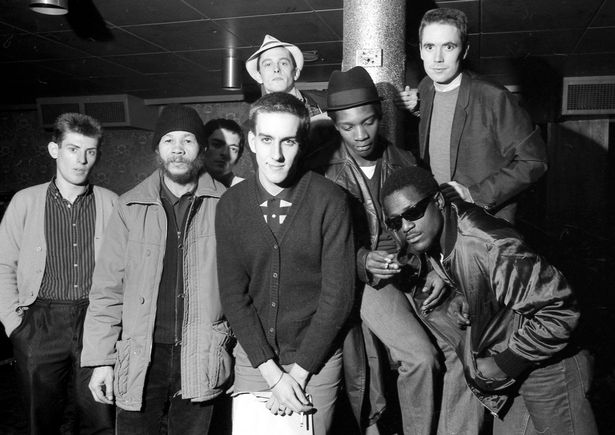
Members of The Specials, with Terry Hall in center front, pose for a newspaper photo.
Terry Hall, center, with The Specials and Rico (Image: Coventry Telegraph)
(By Steve Shafer)

The news of Terry Hall's death on December 18 at age 63 from pancreatic cancer landed like a sucker punch to the gut--and I've been wrestling with how to process and write about it ever since. Several wonderfully insightful pieces about Hall's music and life already have been published--including Alexis Petridis' "Terry Hall was the self-assured eye of the Specials storm" in The Guardian and Neil Kulkarni's "Coventry & A Spirit Of Unbelonging: Terry Hall Remembered" in The Quietus. And Billy Bragg summed up Hall's and The Specials' impact so incredibly well in 280 characters. So, I'm not sure what I can add (but I need to add something).

As I write this, the terrible news of Pelé's death is just sinking in. I had seen him play at Giants Stadium in the Meadowlands in 1977 when I was 11, during his final season with the Cosmos. I've always considered it to be one of the highlights of my life, to have witnessed the greatest soccer player of all time in action, even if past his prime. While I'm reluctant to admit it, it's hitting me harder than Hall's passing--and forcing me to realize that I've always held Terry Hall at a bit of a distance, though I shouldn't be.

Even though he was the phenomenal, irreplaceable voice of my beloved Specials, Hall's dour and perpetually acerbic (though often bitingly funny) public persona left me cold. He was someone who could put anyone in their place with a quick, cutting remark. A man of few words, but they always hit their mark. I've always been wary of and felt at a disadvantage interacting with people this quick and sharp. (I have to mull things over--and often take longer than I'd like to admit to sort out the truth of a situation and articulate my thoughts.)

Having said all that and without ever having met him, I can immediately relate to several aspects of Hall's life and death. For several years after college, I worked as a caseworker at a residence for people with chronic mental illness (much later in his life, Hall was diagnosed as suffering from bipolar disorder). About five years ago, I witnessed a friend of mine--only a few months younger than me--undergo grueling treatment and slowly die from pancreatic cancer. And I've been a devoted fan of The Specials ever since first hearing "Ghost Town" in 1981.

Hall's detached and dispassionate vocals--often delivered standing stock still while the rest of the band exploded in furious motion behind him (as Petridis points out, see the closing credits of Dance Craze)--and fuck-all attitude made him the perfect frontman for The Specials, whose songs were mostly about how adults and their institutions had largely failed their generation. His disaffection with the world was not a pose. Growing up, he was subjected to one of the most horrific betrayals of adult trust imaginable.

At age 12, Hall was kidnapped by a teacher on a school trip in France and sexually abused by a pedophile ring for four days before being punched in the face and discarded on the side of a road. The trauma Hall suffered triggered a deep depression, whose treatment left him addicted to Valium for years and housebound for months (he also dropped out of school when he was 14). Hall also likely experienced emotional numbing--an unconscious psychological defense/survival mechanism common to people who have been severely traumatized where the brain attempts to lessen the pain by dampening all emotions (leaving someone who seems distanced, detached, and unfeeling).

It's not a stretch to argue that this abduction and sexual assault--in addition to his experience of growing up in a decaying, unfashionable Coventry in the 1970s (see Kulkarni's piece above)--lent Hall's voice and stage presence a unique authority and authenticity. In his alienation, cynicism, and emotional remove lay his power as he sang about everything around him--endemic racism and racial violence; working-class youth denied opportunity, purpose, even a satisfying night of fun by a government that didn't give a damn about their future; and the shared constant dread of all life being wiped out in a nuclear war. But his detachment didn't mean that Hall didn't care deeply about how the litany of society's unaddressed and intentionally aggravated ills was impacting Britain's youth. He was just clear-eyed about their plight. And everyone loved him for it.

Two of The Specials' greatest songs that bookend the original band's brief existence--Dammers' "Nite Klub" and Hall's own composition "Friday Night, Saturday Morning"--are both about the inability to take pleasure in a night out on the town. In "Nite Klub," Hall's deadpan delivery of the lyrics "I'm a parasite/I creep about at night" is spectacularly ambiguous. Is this meant to be sarcastic, commenting on the establishment's view of working-class youth on the dole? Or has the narrator internalized mainstream society's low opinion of him and his lot? And the suddenly released white-hot anger in the last line of this verse is devastating: "I don't work/'Cause I don't have to/I don't have to work/There's no, no work to do!" How can you have fun (or be a productive member of society, for that matter) when your life's going nowhere?

The narrator of "Nite Klub" is still hitting the nightspots a few years later in "Friday Night, Saturday Morning," but the piss and vinegar in his belly is gone. It's all now bleakly rote. Hall's unembellished singing conveys the track's boredom, futility, and despair extraordinarily well. But this portrait of Britain's forsaken youth is drawn with great empathy, not self-pity or anger at the powers that be (though Thatcher's the subtle target). And Hall's song contains one of the most universally relatable--and bluntly heartbreaking!--lyrics in pop music history: "Wish I had lipstick on my shirt/Instead of piss stains on my shoes."

In a 2019 interview with Richard Herring’s Leicester Square Theatre Podcast, Hall stated:

"I find it quite easy to forgive and forget. It’s like, you know, going back to my abduction, it’s like you can let that eat away at you but then well you know it’s paedophilia and it’s like part of life really.

"It’s unfortunate it happened to me but you can’t just let it destroy your life, it’s not good."

While there's much to unpack here (the forgiveness, his resilience), Hall's observation that child sexual abuse is "like part of life" is shocking. But considering what took place in the Catholic Church worldwide for decades--and god knows in how many other institutions that dealt with children--he's not wrong, is he? 

Clear-eyed to the end.

+ + + +

I offer my deepest condolences to Terry Hall's family, bandmates, friends, and fans.

+ + + +

(Updated on 1/3/2023 to include information on emotional numbing.)

+ + + +

Thursday, October 6, 2022

Shots in the Dark: The Adjusters "Otis Redding Will Save America"

The album cover features images of a factory, children shooting water pistols at each other, and a large 1970s American car parked on a street.
Editor's note: Shots in the Dark spotlights Third-Wave ska releases that should have been massive hits on the scene but, due to bad timing, poor luck, or a fickle record-buying public, were lost in the fray.

(Appreciation by Steve Shafer)

The Band: The Adjusters, an overtly left-wing, mod-ish ska-soul band from Chicago who were heavily influenced by The Redskins (anti-fascist, socialist soul-rockabilly-punk skinheads, who released several singles and one classic album, Neither Washington Nor Moscow) and Billy Bragg (anti-fascist, socialist folk-punk rocker who still endeavors to write protest songs that are about both the personal and political, and has released a host of singles and albums, including my favorite Talking to the Taxman About Poetry, which sports the best-ever critique of Reagan's Cold War-era USA: "Help Save the Youth of America" (some of which is terrifyingly relevant again*)). This interracial, mixed-gender band was composed of Daraka Larimore-Hall (who is half-Jamaican) and Jessica Basta on vocals, Jason Packer on guitar, Matt Parker on organ/piano, Rench on drums, vocals, and samples, and Joshua Thurston-Milgrom on bass.

The Sound: The Adjusters' incendiary 1997 debut Politics of Style (Jump Up Records) veers between Stax soul, JB funk, rootsy reggae, and traditional (not 2 Tone) ska. Their 1998 follow-up on Moon Ska Records Before the Revolution (produced by Victor Rice) further refined the formula to greater effect with an even better collection of tracks (full disclosure, when I was at Moon Records I worked with the band promoting this record). 2003's Otis Redding Will Save America (blessed with a mind-blowingly good co-production by Rice and Rench) blended hip-hop, Big Beat, and trip-hop into the mix for a searing and unblinkered look at America in the years just before and after the Twin Towers fell.

The Release: The writing, recording, and mixing of The Adjusters' Otis Redding Will Save America  straddled one of the most dramatic paradigm shifts in American history: the immediate pre- and post-9/11 years. The relatively peaceful and prosperous Clinton '90s wound down with an absurd impeachment over lying about sex (and we didn't fully comprehend the portents of the 1993 World Trade Center attack and 1995 Oklahoma City bombing and how they would shape the next two decades). The first dotcom bubble burst and the Y2K freakout was (thankfully) a bust.

The George W. Bush years started badly with an election swung his way by the right-wingers on the Supreme Court and only went down from there. After apparently ignoring our intelligence service's red alert signals about the coming terrorist attacks, Bush led the nation into a particularly nightmarish and tragic period in the USA following 9/11. It all culminated in the appalling--and completely unnecessary and unprovoked--2003 Iraq War (that eventually killed around 4,500 American servicepeople, tens of thousands of Iraqi insurgents, and around 600,000 Iraqi civilians). Even as it was all unfolding back then, it was obvious that the George W. Bush Administration was lying that Iraq had weapons of mass destruction and that Saddam Hussein was behind the 9/11 attack. They simply wanted to justify a preordained invasion of that country (when it was likely that elements within the Saudi government helped the al-Qaida terrorists carry out their mission).

The 9/11 attacks did more than murder several thousand Americans. They shook us to our core and unleashed our darkest impulses in our so-called War on Terror--leading us to abandon our laws and values to assuage our security fears and nurture our lust for revenge. And our country did more to destroy itself and betray everything that America purports to stand for than 12 hijackers could ever dream of accomplishing.

(Just as a reminder, here are some of the appalling lowlights of our War on Terror: the torture--and waterboarding is torture--and indefinite detention of suspected terrorists; the use of extraordinary rendition; the illegal monitoring and wiretapping of Americans' e-mails and phone calls under The Patriot Act; the profiling and quasi-legal surveillance of American Muslims; the "unitary executive" theory and use of Presidential signing statements; the Bush Administration's deliberate misinterpretation and shredding of our nation's laws; and does anyone remember that insane psych-op weekend when Americans across the country freaked out after the White House suggested that Americans buy duct tape and plastic sheeting in case of a dirty bomb/bio-chemical attack?)

The Adjusters believed that America--which has never quite lived up to its promise in the Declaration of Independence that all people are created equal and have the right to life, liberty, and the pursuit of happiness--had not only lost its shit but had badly lost its way.

While the band was recording the album in Version City's spartan basement studio on East Third Street in Manhattan, one of the band members visited the restroom of the bar upstairs and noticed something written on the toilet stall wall (in what would become their own Smells Like Teen Spirit moment): Otis Redding will save America.

Eventually, The Adjusters realized that this phrase encapsulated everything they were trying to convey with this album. Otis Redding, the "King of Soul," had attempted to goad America into locating its conscience as it staggered through one of its most turbulent, violent, and hate-filled decades. He was one of the first Black soul singers who broke through to the white rock audience (see this video from the '67 Monterey Pop Festival) as an undisguised, undiluted, and unbowed Black man (in the 1960s, Black men accepted within white pop culture usually weren't permitted to be regular human beings who could express, or be the overt object of, sexual desire--see the constraints placed on Sidney Poiter by Hollywood). This was at a time when America was forced to come to terms with its white supremacist/Jim Crow legacy and recognize and support the equal/legal rights of Black American citizens; endure a string of devastating political and racial assassinations (JFK, MLK, Jr., RFK, Malcolm X, Medgar Evers, and many lesser-known Civil Rights martyrs); and muddle through an unwinnable, imperialistic proxy war with China and Russia in Vietnam that killed 58,200 young US soldiers (average age: 23) and millions of Vietnamese. 

To give some context to Redding's extraordinary and unprecedented impact on American society, check out this appreciation in The New Yorker: "Marching in place to keep pace with the beat, pumping his fists in the air, striding across stages with a long-legged gait that parodied his “down home” origins, Redding’s confident yet unaffected eroticism epitomized the African-American ideal of a “natural man.” White audiences of the time had never seen anything like it. The effect was so powerful that Bob Weir, of the Grateful Dead, said, of Redding’s performance at the Monterey Pop Festival, "I was pretty sure I’d seen God onstage"...In the way he looked and the way he sang and the way he led his tragically unfinished life, this princely son of Georgia sharecroppers was a one-man repudiation of the depraved doctrine of "white supremacy," whose dark vestiges still contaminate our world." (After over 4,000 documented lynchings of Black Americans from 1877 to 1950, the US finally has the Emmitt Till federal anti-lynching bill on the books, which was signed into law by President Biden and defines lynching as "a hate crime that results in death or serious bodily injury.")

To heal the nation, Redding pleaded with everyone to "try a little tenderness," which isn't just about relations between the sexes. The country needed (and still needs) heaping doses of empathy for white America to see Black Americans as their fellow human beings. But Redding also insisted that respect be shown to Black citizens in his hit song transformed into an early feminist and Civil Rights anthem by Aretha Franklin. Notably, Redding's posthumous hit "Dock of the Bay" underscored the loneliness and aimlessness of being rejected by the society that birthed and (reluctantly) fostered you.

While Redding never finished his journey (he died in a plane crash at age 26 along with most of the members of his backing band the Bar-Kays), his music and insistence on being his unreserved self in public on stage offered the hope that America could be a pluralistic society that embraced diversity and recognized everyone's rights equally.

For Otis Redding Will Save America, The Adjusters expanded their sound to further explore/honor Black American music beyond their mod-ska-soul mix and incorporated hip-hop and its musical descendants filtered through British subculture: trip-hop and Big Beat (Lionrock's "Rude Boy Rock" and Sly and Robbie's Drum & Bass Strip to the Bone by Howie B influenced this record enormously). Of course, practically all American popular music was created by Black American musicians: jazz, blues, R&B, soul, rock 'n' roll, and hip hop (Black music is one of the United States' most powerful cultural exports and a primary driver of our entertainment economy). And The Adjusters were about celebrating Black American music.

This expanded musical palette may have been a bridge too far for hard-line ska fans, but The Adjusters never comfortably fit within the confines of the '90s US ska scene, which skewed more towards punk rock (it's worth noting that in its original '76-'77 incarnation, punk stripped rock 'n' roll of its Black origins in R&B and gospel). And The Adjusters' overt democratic socialist stance and political activism through Modern Action and the Democratic Socialists of America was sometimes a sore point among the reactionary, almost libertarian (barf) elements of the ska fan base (even though some of our country's most popular social and educational programs--Social Security, Medicare, Veterans Administration, public schools, public universities, public libraries--are all socialist in nature). But The Adjusters never cared about discomforting the comfortable and privileged (see Daraka's comments about the 1998 Ska Against Racism Tour in the Chicago Reader**).

Like The Specials, The Adjusters wanted their music to move your body and their message to stimulate your mind. So, Otis Redding Will Save America is equal parts party soundtrack and political rallying cry--both essential for surviving desperate times. And it's one of the best albums that the '90s ska scene ever yielded.

Otis Redding Will Save America opens with "WTF Ska" an old school-sounding tune that's laid over a decidedly new school drum loop (this ain't downtown JA!). It's the instrumental version of "When Things Fall," which appears later on the record and is an appeal for solidarity across race and class lines in the face of injustice and adversity--and pretty much sums up the theme of the entire album. The Adjusters' superb and powerful cover of Gil Scott-Heron's "Gun" is about the fraying of the social contract (to the point where every one of your fellow citizens is a potential threat) and a society where violence and killing are both way of life and entertainment.

Everybody's got a pistol
Everybody's got a .45
And the philosophy seems to be
At least as near as I can see
When other folks give up theirs, I'll give up mine

This is a violent civilization
If civilization's where I am
'Cause every channel that I stop on
Got a different kind of cop on
Killing them by the million for Uncle Sam

But Saturday night just ain't that special
Yeah, I got the constitution on the run
Yeah, 'cause even though we've got the right
To defend our home, to defend our life
You got to understand to get it in hand about the guns


"Can't See the Light," an original, traditional-sounding rocksteady cut (that features Dr. Ring Ding), is about being comfortably numb and disconnected as the world burns around you--and refusing to take sides or even recognize right from wrong (and alludes to The Clash coming to terms with reality with this lyric: So safe and warm in your nice suburban home). "Master Blaster" is, of course, a Stevie Wonder cover. It's his 1980 reggae tribute to Bob Marley that incorporates part of "Jammin'" and celebrates Zimbabwe's hard-fought independence from their colonial British overlords and Black self-determination, in general (Jessica Basta takes lead vocals here and really shines).

Sounding like a lost Public Enemy cut from It Takes a Nation of Millions to Hold Us Back, "If You" is an extraordinary and wickedly fierce hip-hop track featuring the mighty T.O.N.E. on vocals and built on a sample from Wagner's "Ride of the Valkyries" (most famously used during a brutal attack on a Vietnamese village just after the "Charlie don't surf scene" in Apocalypse Now). It offers sharp commentary on how bringing about real change demands so much more than performative gestures.***

If you're sick of seeing Black people gettin' shit
Raise your fist (raise 'em up, raise 'em up)
And if you're sick of seeing women gettin' hit
Raise your fist (raise 'em up, raise 'em up)
And if you're sick of seeing poor people gettin' dissed
Raise your fist (put 'em up, put 'em up)
And if you wanna do something 'bout it
You gotta do more than raise your fist to get pissed

The downbeat "Monkey Hate Reggae" is about a disaffected youth in a no-future rust belt town coming under the sway of a "right-wing libertine" and acting out violently as a result (shades of "Clampdown"). The ebullient "The Fightback, Part II" revisits and amps up this funk-powered Before the Revolution track, but recasts its lyrics to laud the massive antiglobalization protests at the 1999 World Trade Organization's meeting in Seattle ("Corporations split the world in two/Which side, which side for you?...You can't fight the man alone/Fuck with the people and the people fight back").

The instrumental booty-shaking dancefloor-filling portion of Otis Redding Will Save America is a collection of genre-bending trip-hop tracks packed with elements of reggae, funk, and hip-hop, plus samples galore (this entire album features some seriously deep grooves and crazy, next-level rhythms thanks to secret weapon Rench). The awesome "Mumia in Tibet" (which refers to Mumia Abu-Jamal) is like a drum 'n' bass mash-up with something off Jump With Joey's Ska Ba. "Boomstick" borrows Musical Youth's intro to "Pass the Dutchie" ("This generation...rules the nation...with version!") for this fantastic percussive workout. And "Supergoodlookin" brings the funk for when you want to get down and funky ("...take it home if you like it/Finger-licking good/Take it home if you like it").

Otis Redding Will Save America concludes with the sobering reality of "It's Like That." The struggle for equality and social/economic justice is far from over and must continue at all costs, despite people's apathy and the considerable power of the forces perfectly happy with/exploiting the status quo: "Can't tell the rich man to stop scheming/But we can change this shitstem/If only we look past the horizon...You may not feel the situation/But give it a generation/It's not gonna look good to my grandchildren."

The Ugly Reality: The Adjusters' Otis Redding Will Save America was released just a few years after the ska meltdown at the end of the 1990s when the scene was abandoned by the wannabes and driven/shamed back underground. So, the audience to enjoy it and the scene infrastructure to promote it was largely gone. And it didn't help that Otis Redding Will Save America was only available as an import from Grover Records in Germany. Right after The Adjusters finished recording the album, Moon Ska went under (on December 17, 2000), but Bucket was kind enough to release the unmixed masters to the band so they could finish and issue the record elsewhere. After the album was released by Grover, plans were in place to tour Europe in support (Daraka was living in Norway at the time and other members of the band took leave of their jobs or quit), but everything was canceled at the last minute. The band broke up as a result--and none of the tracks on Otis Redding Will Save America were ever played live.

It's also incredibly ironic that an album about the battle for America's soul has never been released domestically. But perhaps worst of all is that these songs about racism, hatred, inequity, gun violence, and the longing to change the power structure of our economy and political system are still painfully relevant almost 20 years later, maybe even more so now than they were in 2003.

+ + + +

Notes:

* I happened to catch Billy Bragg at The Beacon Theater on his brilliant first tour of North America in 1984 opening for Echo and the Bunnymen during their magnificent Ocean Rain tour.

** [From the Chicago Reader's "Ska's Lost Cause" article:] "The Adjusters’ Larimore was more skeptical. “Not talking about racism as a system, or racism as something that you should be actively fighting against, but talking about it like, ‘You shouldn’t be mean to black people,’ is just ridiculous,” he said. “It’s like the 2-Tone take on racism, which in the 2-Tone context meant something completely different. There you had a racially diverse scene where people were beating each other up, so going out and saying ‘Hey, don’t beat each other up’ was a progressive thing and part of the more socialist agenda of the people behind 2-Tone. But going to a ska crowd that’s 99 percent white and pretty solidly liberal–especially on race issues–and saying ‘Don’t beat up black people’ is like going out and saying ‘Don’t molest children.’ They might as well do Ska Against Incest.”"

*** Here are some of my favorite verses from "If You" worth quoting here:

If I'm a villain
Let's love the penicillin
I'm not sick with crimes
I'm sick with rhymes
New gang bang
I bang slang for fame
Guiliani, ha!, punany
The same thang...

And

Smiling faces lyin' to the races
You got a facelift, but you're still a racist
You might like your blunder
My hatred alone will rend you asunder
I've got a mind to triumph my will
Look in my eyes, got expression to kill
Syllogisms for your fascisms
You won't find me in your high-tech prisons
Damn!


+ + + +

Much thanks to Daraka Larimore-Hall for filling in a few of the blanks and providing several corrections.

+ + + +

Saturday, March 13, 2021

Duff Guide to Ska Fast Takes: Madness and T-Killas!

Various members of Madness in an assortment of costumes from their many albums appear in the windows of an old brick mansion, as well as in a car in front of it.Under a field of red and black stars, a skeleton kneels down before a masked girl with her fist in the air.(Reviews by Steve Shafer)

As my friends at Stateside Madness recently pointed out, even though there have been loads of Madness compilations released in the UK over the years, only four have been issued in the USA--and none of them have included tracks past 1986! So, the release of the twelve song Our House: The Very Best of Madness (CD/LP, Union Square Music, 2021) is more than overdue and will help the casual Yankee Madness fan catch up on what they've been missing as of late. There are cuts from 2009's outstanding The Liberty of Norton Folgate (read my review of the album and film) and 2016's Can't Touch Us Now (read my review of it here)--wot, nothing from 2012's Oui Oui, Si Si, Ja Ja, Da Da?--plus the 2019 digital single "Bullingdon Boys" (read my review here), which has never previously received a physical release! Even though I have all of their albums, I'll sheepishly admit that I picked up this comp just to have "Bullingdon Boys." Such is the life of an obsessive vinyl collector. (Also make sure to check out Stateside Madness' brilliant interview with Madness guitarist Chris Foreman!)

I'm not exactly sure why Germans have such a knack for making really great ska. But if you like The Busters, No Sports, The Frits, The Butlers, El Bosso und Die Ping Pongs, Bleichreiz, Skaos, The Braces, Dr. Ring Ding, The Senior Allstars, Bluekilla, Masons Arms, Yellow Cap, etc. as much as I do, make sure to add T-Killas to the list. Their incredible new album Awareness (CD/LP, Fire and Flames Music/Grover Records, 2020; and available in the USA through Jump Up Records) is a mash up of melodic 2 Tone/early '90s Krautska (particularly The Busters/No Sports/The Frits), and The Clash, The Jam, and The Adjusters (and note that those last three bands were fiercely leftist). In the midst of seemingly everyday songs about going out and having fun, pursing women or men, and just trying to earn enough to get by in life, T-Killas pointedly include messages that are anti-fascist, and pro-socialist and gender equity. Ska fans longing for new protest songs to address some of the many injustices and evils out there have another album for their arsenal!

In what is clearly the single of the album (that I first heard through the Do the Dog Ska-A-Go-Go, Volume 3 comp), the irresistible knees-up singalong "Dandy and Rude" gleefully trades in bad-ass myth-making while celebrating rudies/workers' unity and purpose:

'Cause tonight I'm out with the most special one
When he's out he spills entire bars and more
He burns whole blocks dancing to the rebel sound
He roars like a lion until he sleeps on the ground

He's so dandy and rude--you will never get this fool!

'Cause tonight I'm out with the most special one
When she starts to rumble, the jungle is gone
She drinks the enemy's blood out of her red bowl
Who says you got to be tall to kick the shit out of an asshole?

Fight, drinking all night long
Chanting beloved workers' songs
Crew love, AFA skinheads
Nothing to prove--black and red


"Rudie's Struggle" challenges gender stereotypes--particularly rude boy/skinhead machismo: "'She's so soft and she's so sweet'/You think she's not a street warrior, oh please...He or she/Poor categories/Do you want to preserve the classic roles?/Or a counterculture without sexual harm for all?" Maybe a little is lost in translation, but you get the gist. "Gonna Go" is a sweet reggae love song about that special someone you can always rely on. "Riot Ground" sounds like a Billy Bragg/Joe Strummer punk rock collaboration sending up a flare to the powers that be to take note that not all is hunky dory with the masses: "You give 'em hope, you give 'em peace, education and disease/But is going on--if there's a fucking wake up call?" And perhaps the most powerful track on the album is the anti-capitalist/pro-socialist and shout out of solidarity with the workers of the world mod cut "Calling for Stars":

I don't get no money for my rent
I just keep on slaving till the end

This is another good goodbye
To our empty life
It's another calling for the black, black star
And it's another calling for the red shine
It's another calling for the red, red star
And it's another calling for the black light

As someone living in a country plagued by white supremacy and enormous income inequality--and where far too many people fear and don't understand--and don't care to understand--what socialism and antifa actually mean, it's both striking and heartening to hear catchy, positive songs about both. We really need them, so keep 'em coming!

+ + + +


Thursday, July 28, 2016

The Selecter Return to the USA and Mexico This Fall!

The Selecter with Pauline Black and Arthur "Gaps" Hendrickson will be performing in the USA--they haven't been here since 2013--and Mexico this November in support of their excellent 2015 album Subculture (read The Duff Guide to Ska review of Subculture here).

Here are The Selecter's dates for the rest of the summer and fall in the UK, USA, and Mexico:

Sat 6 Aug: Kaya Festival, Wales UK
Fri 12 Aug: Farmer Phils Festival, Shropshire UK
Sun 14 Aug: Boomtown Fair, Nr Winchester UK
Sat 20 Aug: Great Northern Ska Festival, Manchester UK
Sun 21 Aug: Beautiful Days, Devon UK
Sat 27 Aug: Victorious Festival, Portsmouth UK
Sat 3 Sept: Monkey's Music Club, Hamburg DE
Fri 9 Sept: Undercover Festival, Brighton UK
Sat 17 Sept: Ramsbottom Festival, Lancashire UK
Thu 29 Sept :Old Fire Station, Carlisle UK
Fri 30 Sept: Town Hall, Paisley UK
Sat 1 Nov: Loopallu Festival, Ullapool UK
Sun 2 Nov: Independent, Sunderland UK
Thu 6 Nov: The Gramercy Theatre, New York USA
Fri 7 Nov: Chop Shop, Chicago USA
Sat 8 Nov: The Gothic, Denver USA
Mon 10 Nov: The Independent, San Francisco USA
Tue 11 Nov: The Regent, Los Angeles USA
Wed 12 Nov: The Glasshouse, Pomana USA
Thu 13 Nov: The Casbah, San Diego USA
Sat 15 Nov: Global Ska Festival, Mexico City MX
Sun 18 Dec: Copper Rooms, Coventry UK

+ + + +

In other Selecter news, they headlined Billy Bragg’s Leftfield Stage @ Glastonbury, toured Australia in March, and Pauline and Gaps have done a slew of shows in the UK with Jools Holland’s R & B Orchestra (and will be doing more with them in the fall). They urge everyone to "stay vigilant, resist all forms of racism and sexism if you see or hear it and enjoy ska/2-Tone music wherever you can find it."

+ + + +

Tuesday, March 15, 2016

Duff Review: The Crombies "Dance Crazee"

Jump Up Records
2016
Deluxe CD Box/CD/Cassette
Artwork by CHema Skandal

(Review by Steve Shafer)

I've been hearing about how great The Crombies are--and waiting for this album to come out--for what's seemed like an eternity. So, it's a thrill/relief to report just how fantastic and enjoyable their debut Dance Crazee is! The Crombies' single-minded mission is to make rollicking, good-time 2 Tone music, whether they're covering vintage JA and late 70s UK ska, versioning songs that are a bit further afield, or creating new 2 Tone-like classics. And they succeed brilliantly! (Based on what they've captured in these recordings, The Crombies must be one hell of a good night out--come to NYC whenever you can!) So, put it on, crank it up, and be ready to sing along and move your feet!

Dance Crazee opens with a nod to The Toasters' "Frankenska," employing the same maniacal laughter over the first few measures of J.S. Bach's "Toccata and Fugue in D Minor" during the intro to The Crombies' boss version of The Munsters' theme, which they've re-titled "Monster Ska." (The Forest Hillbillies also recorded a ska version of this song back in 1986 for Gaz's Rockin' Records.) This is followed by a rabble-rousing, knees-up take on Niney the Observer's dread vision of "Blood and Fire," re-recorded for Dance Crazee (this song also appeared on The Crombies' 2011 debut single along with "Mad at the World").

The lurking menace always present in Mike Park's vocals really comes through on the one Crombies original on the album, the bitter "It's Not You" ("Now as I walk along this place/I used to walk along with you/I smell the scent of your perfume...I double-take, but it's not you/It's not you"). The Crombies' take on Prince Buster's "Wash Wash" (which itself is a cover of Beasley Smith's and Haven Gillespie's 1949 pop-spiritual "That Lucky Old Sun"; fun fact--mod rhythm and blues fave Georgie Fame played keys on the 1964 Prince Buster recording of "Wash Wash") veers fantastically into blissful jump blues territory and sounds like something that wouldn't be out of place on More Specials (it's similar in vibe and spirit to "Enjoy Yourself"). "Mad at the World" is a repurposed 1998 Deal's Gone Bad fave (several Crombies were in DGB) about, if I can paraphrase Homer Simpson, alcohol being the cause of and solution to all of life's problems: "Can't drink enough to get my head right/Know what they say/Some win, some lose/Finish up to a brand new surprise/Movin' sidewalks, street lamps whirl/Spitting fire till I see your eyes/I'm mad at the world!"

The Crombies' defiant cover of The Clash's "English Civil War" (where Joe Strummer borrowed the American Civil War-era song "When Johnny Comes Marching Home" to issue an anti-fascist warning in reaction to the rise of the National Front in the UK in the late 70s) was previously featured on the excellent and very essential The Clash Goes Jamaican double LP/digital compilation (Golden Singles Records, 2013), as well as a split single with the Green Room Rockers (who covered "Clampdown"). In The Crombies' hands, "The Prince" becomes a full-fledged ska song with a serious, danceable groove--that may top Madness' awkward, herky-jerky original! The Specials' Roddy Radiation adds his distinctive rockabilly ska guitar sound to his own composition of a fallen young woman, "Hey Little Rich Girl" (Roddy's also featured on "It's Not You").

Things shift dramatically with The Crombies' stellar reading of Billy Bragg's  "Levi Stubbs' Tears," a despondent tale of a woman perpetually down on her luck who sort of makes it through life with the music of The Four Tops giving her a measure of comfort (it's from Bragg's 1986 album Talking to the Taxman About Poetry). Their choice of this cover and their interpretation of it are the highlight of the album--and suggest many more great things to come. I wasn't that familiar with Toots and the Maytals' "It's You" before hearing it on this album; this great rendering is something you might expect from The Specials, circa 1979. The Crombies' party finishes with a sweet cover of Prince Buster's "Dance Cleopatra" that sounds like Gaz Mayall's Trojans with Dick Dale on lead guitar.

While The Crombies' Dance Crazee may not be revolutionary (it doesn't aim to be), it is filled with irresistibly fun and expertly (and lovingly) crafted 2 Tone ska that you'll want to listen to over and over. And, these days, everyone could use a little more upbeat, smile-inducing, "more life!" music in their lives.

+ + + +


Saturday, February 11, 2012

The Selecter in Texas, 1980

I always find it a bit weird when I'm reading about a particular topic and then--seemingly randomly--I come across all of this additional info about the same thing, even though I'm not actively seeking it out.

As I mentioned a few posts ago, I'm reading Garry Bushell's "Dance Craze: Rude Boys on the Road! How The Specials, Madness, The Selecter & Co. Conquered the World" (which you can pick up in the USA from Jump Up Records) on the subway, to and from work.

One of the more interesting chapters is about The Selecter's 1980 USA tour--particularly their swing through Texas, where they stop for a picture in front of the Southfork Ranch, which was the setting for the TV nighttime soap "Dallas," and a truck full of pissed-off "good ole boys" mumbling the "N-word" showed up in response to the band's non-white presence in the area. (Yet another low moment in the long and pathetic history of race relations in the history of the U.S.) Anyway, on my FB page today I came across a photo of that exact moment (via New Wave/post-punk site Slicing Up Eyeballs) taken by the band's manager at the time, Juliet Wills (who is now Billy Bragg's partner).

Check out the photos (which include some shots of the band in LA for their gig at the Whisky; making the "Missing Words" video; and on the Old Grey Whistle Test) here.

Tuesday, September 13, 2011

Duff Review: Usual Players "Street Ska, Volume 1"

One Thirty-Four Records
2011
CD

North London band the Usual Players produce a spirited brand of spiky post-2 Tone ska that could be best described as what you'd hear if Dick Lucas of Citizen Fish were ever to front The Toasters. (Yes, Usual Players singer Lewis Norton's voice is strikingly similar to Lucas'--compare this Citizen Fish track to one of the UP's tracks below). As the album's title might suggest (and the singer's working class accent re-affirms), the world perspective presented here is that of the average man in the street--but the kicker is that all the lyrics here essentially relate to having lived long enough and been let down so often that you've become completely disappointed by life.

Songs on Street Ska include those about being totally uninspired by corporatized, rebellion-free modern rock ("The Soul of Rock and Roll (is Dead)"); guiltily trolling for semi-anonymous sexual liaisons on Facebook ("Fancy a Facebook"--a new crude phrase for the digital age!); dysfunctional relationships with the opposite sex ("Free" and the stuck-in-my head "Cool Girl"); disgust at a political system that only rewards the powerful and rich ("Right on John"); a tale about an immigrant from Italy who pays her way through prostitution (the reggay-ish "Santa Maria"); and struggling to find an escape from the boredom and monotony of school and work, but finding yourself trapped in the same old same old and being painfully aware of your life slipping away ("Bad Pills," So Whatford"). Despite all the cynicism, disillusionment, and bleakness on display here, it's not all grim. There is much wit and humor to be found in the Usual Players' lyrics (from "Tatt's Too Bad": "Hooligans with Buddha on their arms/but they can't even tell you what religion reads the Qur'an")--plus it doesn't hurt that the songs are get-up-on-your-feet catchy!

In "Right on John," Norton's sung criticism of "how things are" is pretty sharp and furious (but not off the mark): "We like to keep the dog well fed/by keeping half the Third World dead/Fueling our homes and our cars/by the means of illegitimate wars/There's no such thing as climate change/just another one of their controlling aims/Using fear as a way of tax/to keep us on the straight, narrow tracks." But then later in the song, he deflates any trace of self-righteous Bono/St. Bob pomposity by stating, "Don't you just hate the song/when politics are spoken by some musician/It's not that you disagree with the opinion/It's just lame/I know I should do more, join a march/or rally for some cause/But that just seems long/So for now I'll protest in this song." He's got something to say, and the platform to share it...but feels that it's unlikely to change anything (though Billy Bragg might want a word with you, boys).

But what seems to truly raise the hackles of the Usual Players is how all of the obligations and responsibilities that come with adulthood eventually corrupt and grind you down--so that complacency sets in, you make all sorts of moral compromises, and forgo your dreams of greatness for something much less. In "So Whatford," Norton can barely choke back the bile as he blisteringly sings: "Spend your days in the same jobs/Spend your nights in the same pubs/Forty pound for cocaine, that's a shame, mate/You've been taken for a mug/You're poncing money off the government/Exclaiming it's to be your entitlement/You blame everything on immigration/And you call yourselves honest men...No ambition/Just repetition/This is the story and this is the mission/Calling all town rats and estate cats/Your life is over/That's a fact." (Guess it should be mentioned here that the exact town the band is from is Whatford--so this barbed attack is on their own.)

Yet there's a way out and he's taking it (and wouldn't mind it if you'd join him): "Council estate boy that is me/I'm from a place called South Oxhey/Forget what I'm told, I get a bit bold/It's a massive world out here you see...I've got ambition/I hate repetition /This is my story and my mission/Calling all town rats and estate cats/Time to kick off and react...Just stand up and fight it/Shake your heads and reject it/Go take everything/No matter what it costs/Be more than just Whatford."

So the Usual Player's story is that our way of life sucks and just about everyone you know is going to let you down--but their mission is not to surrender. These are rebel songs to see you fight another day in the Age of Austerity...

Duff Guide to Ska Grade: B+/A-


Usual Players - Right on John - One Thirty Four Records by Usual Players

Usual Players - Fancy a Facebook - One Thirty Four Records by Usual Players

Usual Players - Cool Girl - One Thirty Four Records by Usual Players

Usual Players - Santa Maria - One Thirty Four Records by Usual Players

Usual Players - Bad Pills - One Thirty Four Records by Usual Players

Usual Players - So Whatford - One Thirty Four Records by Usual Players