Showing posts with label Chris Blackwell. Show all posts
Wednesday, March 31, 2021
Duff Guide to Ska Fast Takes: Roddy Radiation with The Skabilly Rebels, Bailey Dee with The Kingston Affair, and Travelers All Stars!
(Reviews by Steve Shafer)
The latest single from Chuck Wren's Jump Up Records, Roddy Radiation with The Skabilly Rebels' "Sea Cruise" b/w Bailey Dee and The Kingston Affair's "Sea of Love" (7" color vinyl single, Jump Up Records, 2021), is a throw-back of sorts that deftly underscores how Black American R&B and early rock 'n' roll directly influenced the birth of Jamaican ska music. Both "Sea Cruise" and "Sea of Love" were originally released in 1959--the same year that Laurel Aitken issued the Chris Blackwell-produced, R&B originals "Little Sheila" b/w "Boogie in my Bones"--and it makes complete sense that these marvelous ska covers by Roddy Radiation and The Skabilly Rebels and Bailey Dee and The Kingston Affair work so well, since these are from that peculiar time when the border between the established genre and its about-to-be-born descendant was blurred. For anyone who's a proud, card-carrying member of Gen X, it's likely that your introduction to Frankie Ford's 1959 rock 'n' roll hit "Sea Cruise" (written by Huey "Piano" Smith) came via Rico's cover of it on his wonderful 1980 2 Tone single (though according to 2-Tone.info, he's not backed by The Specials, despite the common misperception otherwise). This terrific version (has Roddy ever sounded happier?) comes from Roddy & The Skabilly's 2016 CD EP Fallen Angel, which also had been featured on a Jump Up freebie comp that was given out through mail-order. And most ska and reggae fans know likely Phil Phillip's classic (and only) hit "Sea of Love" via The Heptones' version. This marvelous take is by the awesome Chicago retro rock 'n' roll singer Bailey Dee, who is backed by The Kingston Affair, which features members of Deals Gone Bad, (who are, of course, referencing the original name of Neol Davies song recorded with drummer John Bradbury and t-bone player Barry Jones which became The Selecter's "The Selecter" and was released on the flip side of The Specials' "Gangster" single). If that rock thing doesn't work out for Ms. Dee, she certainly has a future in ska. This record comes in a variety of cool colors--mine is white--but whichever shade suits your fancy, just don't miss out on this top notch single. If you were wise enough to have snagged a copy of Happy People Records' Rudies All Around, Volume 1 comp a few years ago (read my review of it here), you would have been introduced to the amazing, keyboard-centric original early reggae from Mexico's Travelers All Stars. When you crack open the cellophane on their latest single Reggae Gordo for Days and Extra Days! (Orange vinyl picture sleeve single, Chez Nobody Records, 2020; both tracks were mixed and mastered by Roger Rivas), you'll find a small sticker with this quote from my favorite gutter poet Charles Bukowski: "And when nobody wakes you up in the morning, and when nobody waits for your at night, and when you can do whatever you want. What do you call it, Freedom or Loneliness?" The Travelers All Stars' A side answers that question--it's a sprightly, Harry J-styled instrumental skinhead reggae cut called "Sweet Loneliness" (the kind you only can find moon-hopping in space or in pandemic era lockdowns?). The more urgent "Space Invaders"--more and more aliens keep descending from the sky!--pays tribute to that blockbuster late-'70s arcade game (featured on the single's back cover) that swallowed up a lot of my brother's quarters and time back in the day. This single's title translates to (and promises) "heavy reggae..." and the tracks certainly deliver. This great 45 is available in the USA through Jump Up and can also be ordered from Chez Nobody via Bandcamp (a die-cut arcade version of the sleeve is available that also comes with a patch and enamel pin!).
+ + + +
Labels:
2 Tone,
Bailey Dee,
Chris Blackwell,
Deals Gone Bad,
Duff Review,
Laurel Aitken,
Rico Rodriguez,
Roddy Radiation,
The Heptones,
The Kingston Affair,
The Selecter,
The Skabilly Rebels,
Travelers Allstars
Wednesday, September 30, 2020
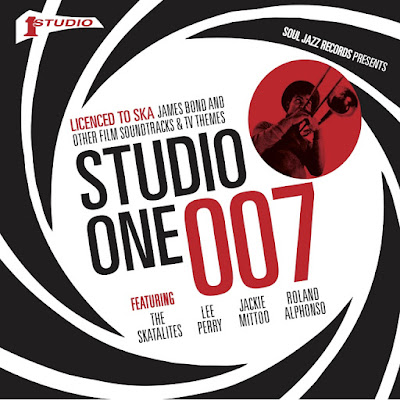
Duff Review: "007 Licensed to Ska: James Bond and Other Film Soundtracks and TV Themes"
Soul Jazz Records5 x vinyl single box set
2020
(Review by Steve Shafer)
While it was common practice for the original 1960s instrumental ska bands to cover popular songs and movie themes of the day, the James Bond connection to the Jamaican music scene was firmly cemented in 1962 during the filming of the first Bond film Dr. No, which was set on the island (as were Live and Let Die and The Man With the Golden Gun). Of course, Bond author Ian Fleming lived in Jamaica on an estate called Goldeneye, and he was the one who recommended future Island Records honcho Chris Blackwell to Dr. No's producers as a location scout and production assistant (the Blackwells were neighbors of Fleming, and unbeknownst to her son, Blanche Blackwell had a long-term affair with Fleming). Chris Blackwell, in turn, introduced composer Monty Norman, who had been hired to write the Dr. No soundtrack, to the "uptown" and more respectable Byron Lee and the Dragonaires (both guitarist Ernest Ranglin and trombonist Carlos Malcolm were in his band), who recorded the calypso-ish music on the movie soundtrack, and appeared in the film performing "Jump Up" (Blackwell apparently can be spied dancing in this scene, too).
In addition to the fact that the first Bond movie was shot in Jamaica, the stylish, womanizing, and legally transgressive Bond character resonated with many Jamaicans, as he was akin to the rebellious rude boy persona associated with toughs in the sound system scene (and street-level gangsters)--and celebrated/decried in the ska music of the early to mid-1960's (see Stranger Cole's "Rough and Tough," The Wailers' "Simmer Down," "Rude Boy," and "Jailhouse," Alton Ellis' "Dance Crasher" and "Cry Tough," Baba Brooks' "Gun Fever," Desmond Dekker "Rudy's Got Soul" and "007 (Shanty Town)," Derrick Morgan's "Tougher Than Tough" and "Cool Off Rudies," The Slickers' "Johnny Too Bad," The Valentines' "Blam Blam Fever," Prince Buster's "Judge Dread," Lee Perry's "Set Them Free," Dandy Livingstone's "Rudy, A Message to You," and dozens more).
In terms of risk management, since the better songs from movie and TV soundtracks already were well-known and liked, it made financial sense for budget-conscious record producers like Studio One's Coxsone Dodd to try to capitalize on their popularity by recording and releasing cover versions given a ska spin by some of the JA's best musicians (and they didn't have to solely rely on their roster of composers coming up with new material to record that may or may not sell). While most popular music is open to individual interpretation--we are free to associate whatever emotions and personal experiences we want to them (despite the songwriters' intentions)--these highly evocative and dramatic film and TV theme songs are specifically crafted to musically brand the traits of their particular fictional leads and frame their back stories. (To put it crassly, the theme songs are more sophisticated, bigger budget jingles to help sell movies instead of breakfast cereals.) Whenever I hear the opening guitar riff of the Bond theme, I'm thinking about how cool and sadistic Sean Connery is in that role, not what I was doing or how I feeling when I first heard it (and I don't even remember when or where I first heard it)--though listening to it always makes me feel cool and deadly like Bond. Within a matter of a few minutes, these theme songs aim to elicit specific moods and memories from listeners, calibrate their expectations for what this show or movie will deliver, and set the stage for all that is to transpire once the action starts. So, in this manner, popular theme songs often create uniform reactions (in terms of emotions and memories) across large groups of people that can be used and borrowed by others via cover versions.
For Record Store Day 2020, Soul Jazz Records collected many these now hard to find and pricey James Bond-related Studio One recordings (plus three others--hence the ridiculously long title of this release) in the superb and instantly collectable 007 Licensed to Ska: James Bond and Other Film Soundtracks and TV Themes 7" singles box set. Almost all of them feature Studio One's ace house band The Soul Brothers--Jackie Mittoo, Roland Alphonso, Johnny Moore and Lloyd Brevitt--who formed right after the dissolution of The Skatalites in the summer of 1965, and were joined by a rotating group of top JA musicians, including Bobby Ellis, Bryan Atkinson, Bunny Williams, Dennis "Ska" Campbell, Harold McKenzie, Harry Haughton, Jah Jerry Haynes, Joe Isaacs, Karl Bryan, Lester Sterling, Lloyd Knibbs, Lynn Taitt, Sam Wells, Vin Gordon, and Wallin Cameron. Dodd, naturally, was at the controls, producing all of these sessions. Notably none of these tracks are straight covers. They've been interpreted through a Jamaican ska-jazz lens by gifted musicians, who have utilized the widespread recognition and appeal of these movie and TV show themes, but transformed them into something new that they own--transmuting commerce back into art.
007 Licensed to Ska kicks off with The Soul Brothers' "James Bond Girl" (1966), a great minor-key Roland Alphonso original that captures the frisson in the sexual allure and possible menace the woman in this role presents to 007 during each mission, and nicely incorporates the John Barry/Monty Norman Bond theme in its intro and outro. It's paired with Roland Alphonso and The Studio One Orchestra's excellent ska-jazz take on "From Russia With Love" (1965) by John Barry and Lionel Bart (Alphonso has a sweet solo here).
Record two features a beautiful Jamaican jazz read of the instrumental version of John Barry's "Thunderball" by The Soul Brothers (the Keyboard King solos), which is backed with Mittoo's awesome 1969 keyboard-heavy reggae funk cover of Dominic Frontiere's "Hang Em High"--from the spaghetti Western-like revenge film of the same name (the track is clearly an homage to Ennio Morricone)--which appeared on Mittoo's Keep on Dancing LP.
"Mr Kiss Kiss Bang Bang" (1967)--Bond summed up in a nutshell--by John Barry and Leslie Bricuss is another instrumental cut from the Thunderball soundtrack (though there is a version with lyrics sung by Shirley Bassey). The Soul Brothers drain the schmaltz to reveal the cracking melodies hidden within that made for a perfect Skatalites-like ska track. The dark and wonderful "007" by The Soul Brothers is credited to Alphonso/Dodd/Mittoo, though some of its horn melodies may share some notes with Barry's "007," also from the Thunderball OST, but the song thoroughly sounds like it's theirs.
Lee Perry and The Wailers' terrific "Pussy Galore," a 1965 Dodd/Perry original, is a fairly conventional ska song with Perry's weirdness lurking beneath the surface, just itching to be released. Scratch warns the listener, "If you are rich and wanna get poor/Just fall in love with Pussy Galore" (the character, apparently based on Blanche Blackwell (!), appears in Goldfinger and is played by Honor Blackman, who was in the TV show The Avengers as Dr. Cathy Gale before Diana Rigg came on as Emma Peel). The Soul Brothers' jaunty "Mr. Flint" (1966) borrows Jerry Goldsmith's theme for the James Bond spoof Our Man Flint.
I never before realized that The Skatalites' incredible 1965 cut "Ball of Fire" (AKA "Echo Four Two") was composed by Laurie Johnson for the short-lived 1961 British police procedural Echo Four Two (Johnson famously wrote the theme to the TV show The Avengers). To this day, it stands as one of The Skatalites' best recorded performances. The set is rounded out with a rare lounge-y interpretation of Barry's "007" instrumental by The Soul Brothers retitled "James Bond Danger Man."
Hopefully, Soul Jazz Records will also release this collection as an LP someday, as something this good should be available to the ska massive, not just those lucky enough to come across this singles box set on Record Store Day. There's the potential for good commerce in making this art available to the masses.
+ + + +
Labels:
Byron Lee and the Dragonaires,
Carlos Malcolm,
Chris Blackwell,
Duff Review,
Ernest Ranglin,
Island Records,
Jackie Mittoo,
Lee Perry,
Roland Alphonso,
The Skatalites,
The Soul Brothers,
The Wailers
Wednesday, September 11, 2019
Duff Guide to Ska Fast Takes: Lee "Scratch" Perry "Rainford"
(Review by Steve Shafer)I have to admit that following 2018's excellent, Black Ark-sounding The Black Album (with ace producer Daniel Boyle), it took repeated plays for me to get into Lee Scratch Perry's latest album Rainford (CD/LP/digital, On-U Sound, 2019), co-produced and co-written with On-U's Adrian Sherwood. Now that all of these tracks are firmly embedded in my head, I've found that it's very much on par with Perry and Sherwood's phenomenal, left-field classic Time Boom X De Devil Dead, recorded with Dub Syndicate in 1987 (Sherwood and Perry's most recent collaboration was The Mighty Upsetter in 2008). Like Time Boom, Rainford is filled with brilliantly inventive sonic weirdness married to quirkily catchy and compelling reggae tunes--and is sure to be recognized as another essential Lee Scratch Perry album in a catalogue bursting with them.
As expected, Rainford contains common Perry themes (driving out/vanquishing evil; toppling the powerful and selfish rich--see the album artwork) and messages (of black empowerment, anti-racism, and the wisdom of Jah's righteous ways). And as always, there's great substance beneath the seemingly mad surface of exhortations and vocal sound effects (Perry mimicking the cries of babies, the bleats, neighs, and grunts of various animals, and horror movie screams). Perry knows full well that his decades-long reputation for being a bit of a lunatic gives him considerable freedom (or lee-way!) to express some heavy and--what establishment society might consider to be--dangerous ideas and opinions.
Album opener "Cricket on the Moon" begins with Perry reciting, "'Repent,' says the cricket on the moon/'Repent,' says the cricket in the room...Mercy call and judgment come." I've never encountered this expression before, but apparently a moon cricket is an ugly racial slur. In this context, Perry is subverting an aspect of this racist trope--essentially, a black person in a sea of whites--as a metaphor for rastas/Jamaicans/people of color struggling against the dominant, sinful Babylon ("I'm the man in the moon/Who kicked the Pope in him raas"). In addition, there could be another layer of meaning rolled into this song, as 2019 marked the 50th anniversary of Neil Armstrong being the first (white) human to step on the moon (when researching this epithet, I also found that supposedly Native Americans have used it as a derogatory term for white people). Naturally, cricket-like chirps are incorporated throughout this wonderful, loping reggae track.
The slightly off-kilter "Run Evil Spirit" is in the same vein of Perry and Max Romeo's "Chase the Devil," with various upstanding rastas (whose religiously proscribed diet includes a lot of fish--hence, "fisherman," with its Biblical echoes) and super humans (Perry refers to the "Bionic Man" at one point!) joining forces to rid the land of wickedness: "Fisherman come/Babylon run...Beggars, users, run/Superman a come/And I've told him what you've done, evil spirit/I said you run/Obeah man a run/Spiderman a come..." Unlike most of the mid-tempo tracks on Rainford, the propulsive, almost hypnotic "Makumba Rock" has the power to pack dance floors and refers to the Brazilian via Africa religion of Macumba: "Voodoo rock/Zodiac rock/Makumba rock...From roots asylum/This is mental zodiac/Are you ready for the black magic?"
Perry pictures himself as captain of a futuristic Black Star Liner on "African Starship" (which revisits/reworks Creation Rebel's 1978 Starship Africa), repatriating the black diaspora to a new Ethiopia somewhere out on the final frontier. While, the hard-hitting, militant-sounding "Kill Them Dreams Money Worshippers" envisions Perry entering the nightmarish, fever dreams of the rich to scuttle their rapacious, predatory scams before they can unleash them in reality and cause good people to suffer ("In the land of dreams/The greed is dead/In the land of schemes/Settle dem debts/In the land of flesh and bones/More than stones and bones/Rocklin' horror movies and scary scenes/A horrible place...We're going to have a black magic for you tonight...We are inviting you down to meet your debt...").
Perhaps the most extraordinary song on the record is "Autobiography of The Upsetter," which is exactly what the title indicates. This is Lee "Scratch" Perry's life's story ("This is my undead biographicie and prophesy"), told with surprising candor, self-awareness, and humor. Perry recounts his familial origins ("My Father was a Freemason, my Mother was an Eto Queen/They share a dream together/Said they're going to make a Godly being"; Rainford is Perry's actual first name); the many highlights of his extensive musical career (and related music industry axes to grind--the listener is reminded that Perry still believes Island's Chris Blackwell to be a bloodsucker); even the episodes of his life where people questioned his sanity, when he was actually profoundly troubled by pernicious goings on in the world around him ("People thought I was mad... Burn down Black Ark/Too much iniquity, too much outerquity was in the Ark/People thought I was crazy...walking backward in Spanish Town"). In sum, it recaps his incredible, visionary artistic legacy, which Perry continues to augment with records like Rainford: "I came up with the Ark, with salvation/And let the people dance/And give the people a chance/I am the Upsetter/Super Ape/Dub organizer, music striver/Pipecock Jackson/Lee Scratch Perry."
+ + + +
Labels:
Adrian Sherwood,
Bob Marley,
Chris Blackwell,
Clement Coxsone Dodd,
Daniel Boyle,
Dub Syndicate,
Duff Review,
Duke Reid,
Island Records,
Junior Byles,
Lee "Scratch" Perry,
Max Romeo,
On-U Sound,
Susan Cadogan
Thursday, November 15, 2018
Duff Review: "Rudeboy: The Trojan Records Story" Documentary
(Review by Steve Shafer)Pitched somewhere between a hagiography of sorts and earnest truth-seeking documentary, "Rudeboy: The Story of Trojan Records," directed by Nicolas Jack Davies, had its US premiere last night at the DOC NYC Festival at a nearly sold-out screening at the SVA Theatre in Chelsea. Commissioned by BMG (which currently owns the Trojan catalogue) in celebration of Trojan's 50th anniversary this year, this 85-minute film employs a mix of short, talking head interviews with a number of often charming key players and commentators (Roy Ellis, Lee Perry, Derrick Morgan, Pauline Black, Don Letts, Ken Boothe, Toots Hibbert, George Dekker, Marcia Griffiths, Bunny Lee, King Edwards, Freddie Notes, Dandy Livingstone, Lloyd Coxsone, Neville Staple, and Dave Barker); archival footage of Jamaica, London, and TV/concert appearances by some of the featured artists; and truly artful recreations of past events with actors portraying various protagonists in this story, such as the late Trojan co-owner Lee Gopthal, Jamaican producer and Trojan sound system owner Duke Reid, and younger versions of Dandy Livingstone, Derrick Morgan, Bunny Lee, and more (they aren't given any lines and are usually shown in fairly ordinary situations in offices, studios, or dances, but nonetheless provide compelling visuals to accompany the audio of some of the interviews or samples of essential Trojan releases).
In sum, they provide a very cursory, but completely appealing outline of the label's history from its founding until it went under in 1975 (the origins and history of ska and its evolution to rocksteady and early reggae receive short shrift, too). Newcomers to Trojan will be intrigued and enlightened by what they learn, but anyone with a deeper knowledge of the label and its affiliated artists will be left wanting more (there's enough to cover here for a doc mini-series). Notably absent from the film is Trojan co-founder Chris Blackwell (after the viewing and brief Q&A with the audience, I asked director Davies about this as we were being ushered out of the theater and he told me that he very much wanted to include Blackwell, but was prevented from doing so, as Blackwell was contractually committed to telling his story for another project; Trojan label director and manager David Betteridge and Rob Bell stand in for him in the film) and with so many stellar artists released on Trojan over the years, one had the nagging feeling that far too many voices were left out (no doubt due to availability, budget and time constraints, and--most tragically--the deaths of many musicians).
At the heart of this film is the story of how a commercial enterprise (the joining of Chris Blackwell's and Lee Gopthal's similar ventures licensing reggae singles from Jamaican producers for release in the UK) unintentionally ended up influencing a generation (or two or three) of youth in the UK and beyond. And the film is most successful at conveying Trojan's enormous cultural and societal impact, as well as showcasing some of the label's finest music (which, of course, is released on the accompanying soundtrack album, full of superlative early reggae/skinhead reggae; a good reminder of how much extraordinary music came from this poor and tiny island nation).
Trojan's string of UK top ten charting pop hits in the late '60s and early '70s (including The Upsetters' "Return of Django," Harry J All Stars' "Liquidator," Boris Gardiner's "Elizabethan Reggae," Dave & Ansell Collins' "Double Barrel" and "Monkey Spanner," Desmond Dekker's "Israelites" and "It Mek," The Pioneers' "Long Shot (Kick De Bucket)," Bob and Marcia's "Young, Gifted, and Black" and "Pied Piper," the Melodians' "Sweet Sensation," and Nicky Thomas' "Love of the Common People") and success with its budget line of Tighten Up compilation albums was a result of skinhead reggae's massive popularity among both black and white youth. The sons and daughters of the Windrush generation (in the '50s and early '60s, over 100,000 Jamaicans emigrated to England after WWII after they were invited to help rebuild the nation and its economy) who largely felt alienated in Britain's overly racist society (there's a scene in the film where soundman Lloyd Coxsone recounts looking for employment at a government job center and finding that every listing was marked with a NCP, an acronym for "No Colored People") found that they shared a deep and common love for reggae with their white working class peers, which enabled all sorts of social connections to be formed (and making that generation of white Britons a bit less racist than the previous). Indeed, as reggae/punk DJ, filmmaker, and musician Don Letts reminds the viewer, the white skinheads of the late '60s/early '70s were, "the fashion kind, not the fascist kind," who were emulating the look of the black working class reggae fans and musicians. As well (as both Pauline Black and Neville Staple note), Trojan's artists and releases helped young, first-generation black Britons find validation and a sense of cultural belonging through the widespread embrace of reggae music and the representation of black British and Jamaican artists on the radio (even if it was usually pirate radio!), TV, and in the press.
The film glosses over the demise of Trojan, which was the result of many factors, including the transition to roots and dub in Jamaica (depriving the label of skinhead reggae to license), the business split between Gopthal and Blackwell (who went on to directly sign reggae musicians like Bob Marley and the Wailers, Toots and the Maytals, and Burning Spear to Island--and figured out how to successfully shape their sound for and market them to a white, rock audience), and the accumulated expenses from re-mixing, re-mastering, and adding pop strings to many later releases that never made it big. Also unmentioned was the common, but ugly and exploitive music business practice in Jamaica at that time--the music producer controlled the copyright/owned the recording. So, the producers of the licensed Trojan hits were paid all of the royalties due, little of which was ever shared with the artists themselves.
All criticisms aside, "Rudeboy: The Story of Trojan Records" really is a great (and fantastic looking/sounding) introduction to the legendary label and all of its stellar music--and longtime ska and reggae fans will enjoy watching it. But anyone seeking a much more detailed and comprehensive history of the label and its magnificent roster of artists will find it in Laurence Cane-Honeysett's newly released (also to mark the label's 50th anniversary) and absolutely essential "The Story of Trojan Records."
+ + + +
Labels:
Bunny Lee,
Chris Blackwell,
Dandy Livingstone,
Dave Barker,
Don Letts,
Duff Review,
Lee Gopthal,
Lee Perry,
Lloyd Coxsone,
Marcia Griffiths,
Neville Staple,
Pauline Black,
Roy Ellis,
Toots Hibbert,
Trojan Records
Monday, December 19, 2016
Duff Guide to Ska Fast Takes: Rico "Man From Wareika/Wareika Dub"
(Review by Steve Shafer)Rico Man From Wareika/Wareika Dub (Double CD, Caroline International/Island Records, 2016): Even though he had lived in the UK since 1961 and had played on numerous records as a very respected and in demand session trombone man for Laurel Aitken, Dandy Livingstone (performing on "Rudy A Message to You"), Joe Mansano, Georgie Fame, and many others (for labels such as Blue Beat, Planetone, Ska Beat, Collins Downbeat), as well as releasing several albums of his own on Pama and Trojan, Rico Rodriguez (check out our bio of him here) wasn't well-known much beyond the Jamaican immigrant community and the devoted subculture of mods and skinheads until Island signed him in 1976. By that time, Chris Blackwell had begun to experience enormous success in marketing reggae to a rock audience--specifically with Bob Marley and the Wailers--and intended to repeat/build upon it with newly signed artists like Toots and Maytals, Burning Spear, and Rico Rodriguez.
Rico recorded Man From Wareika (its title track a tribute to Rico's friend and Alpha School mentor Don Drummond who first brought Rico to the Rastas up on Wareika Hill; this song is a version of Drummond's "Green Island") with top reggae musicians (Sly Dunbar, Robbie Shakespeare, Bobby Ellis, Eddie Thorton, Dick Cuthell, Ansel Collins, Karl Pitterson--who also produced the majority tracks here--and many more) during sessions in England at Island's Hammersmith Studios and Jamaica at Randy's and Joe Gibb's studios. A few months prior to Man From Wareika's release in 1976, Rico toured the UK with Bob Marley and the Wailers, which helped generate advance interest in his album (and in 1977, Rico opened for Marley on the European tour in support of Exodus). Man From Wareika received positive to stellar reviews and sold well-enough that Island released an extremely sought after handmade-looking white label dub version through its Ghetto Rockers imprint and a series of Island 12" singles in 1977 and 1979--"Africa," "Ska Wars," "Dial Africa," "Take 5," and "Children of Sanchez." Having said that, Rico's heavily jazz-influenced instrumental reggae was a bit out of step with the contemporary roots reggae of the mid-70s, which limited Man From Wareika's appeal to some degree (though Jerry Dammers took note, which led to Rico essentially joining The Specials a few years later and achieving even greater popularity and acclaim). But listening to it today, one recognizes that this a phenomenal album--a masterpiece of Jamaican jazz--though nowhere as near well-known and celebrated as it should be.
This definitive 40th anniversary release of Man From Wareika marks the first time that Wareika Dub has been available on compact disc outside of Japan (where it was issued in 2004) and this double CD features 15 bonus tracks--comprised of cuts from many of the Island 12" singles, a few tracks from the Man from Wareika sessions that were first released on Roots to the Bone in 1995, and five terrific unreleased songs (vocal versions of "Africa" and "(Free) Ganja" with Ijahman Levi; a cover of Lee Morgan's "The Sidewinder"; and Rico's "Shabeen" and "Night of the Bongo Man," which features Count Ossie). Fans of Rico will need this in their collection--but anyone who loves reggae and Jamaican music should really give it a shot, since it's that crucial.
One hopes that this re-issue will lead to expanded releases of Rico's two albums for 2 Tone: That Man is Forward (1981) and Jama Rico (1982). The later has never been released on CD, which is shocking, as its an extraordinarily good album (it may be Man From Wareika's equal or better) and very hard to find on LP these days.
+ + + +
Labels:
2 Tone,
Bob Marley,
Chris Blackwell,
Count Ossie,
Dandy Livingstone,
Don Drummond,
Duff Review,
Georgie Fame,
Island Records,
Jerry Dammers,
Laurel Aitken,
Rico Rodriguez
Thursday, March 11, 2010
Jimmy Cliff Joins the Rock 'n' Roll Hall of Fame
On Monday, March 15, ska and reggae great Jimmy Cliff will be inducted into the Rock and Roll Hall of Fame at a ceremony at the Waldorf Astoria Hotel in New York City. He is only the second reggae artist ever to be included in the Rock and Roll Hall of Fame after (not surprisingly) Bob Marley.I'm sure the irony of this is not lost on Jimmy, as in the early 70s under the careful guidance of Leslie Kong, he was poised to become a huge cross-over superstar, had his then-label Island Records not ignored his career in favor of Bob Marley's (did Chris Blackwell think that rock fans could only handle one reggae-rocker at a time?). For the voting members of the Rock and Roll Hall of Fame, the choice of Jimmy Cliff for induction does make perfect sense--back during my college days in the mid-to-late 80s, no matter what your musical scene--whether it was rock, metal, the Dead, or new wave--everyone had two reggae records in their collection: Bob Marley's Legend and the brilliant soundtrack to The Harder They Come. It was as if they were issued to every teenager in my generation when they turned sixteen--you can almost imagine some deadpan Leslie Nielsen-type narrating a cheesy "hygiene" film to prepare us for adulthood and intoning, this is reggae, kids...and it's damn good!
+ + + +
Read about Jimmy's fascinating rise to the top (I didn't know that he was discovered at 14 by Derrick Morgan, who introduced him to Leslie Kong, who in turn produced all of Jimmy's ska hits like "Miss Jamaica," "King of Kings," "One Eyed Jacks," and "Pride and Passion," which were released in the UK on Island Records--a label that Kong then co-owned with Chris Blackwell and Graeme Goodall) and his razor- close brush with mega-Bob Marley-like fame in this great bio from All Music Guide.
Trojan Records also has a nice overview of his career on their site.
Gibson has unearthed a never before published interview with Jimmy Cliff from 2004.
Lastly, here's a current interview with Jimmy Cliff in Spinner, where he talks about his new record, tour of the US, and reaction to his inclusion in the Rock and Roll Hall of Fame.
+ + + +
Thursday, May 7, 2009
Madness: The Liberty of Norton Folgate
Thirty Years into their career, the Nutty Boys write a love letter to London. You can't accuse Madness of overdoing it; this is only their second album of all-new material since 1985's Mad Not Mad. Thankfully it was worth the wait. Named for a corner of the City of London that was legally autonomous until 1900, it's a themed, time-shifting salute to the capital in all of its infinite variety. Using the familiar pop-reggae sound of yore with singer Suggs, in tragi-comedian mood, it energetically represents the band's sombre, complicated side that doesn't always show at the hit-packed live gigs. In these songs marriages fail, things get worse as you get older and joys are fleeting, but it's depth not length that count in time, and ultimately, as on the blissful escape of Africa and the mystic title track's astonishment at a city "sprung up from the dark mud of the Thames," the results are uplifting. Still totally themselves, Madness have made the album of their career.The Liberty of Norton Folgate will be available as an import in the US on May 19 through Amazon and other fine retailers.
Here's the first single from the album, "Dust Devil" (which is available as a 7", 10", CD single, and download on May 11th)...
And here's the band on Later with Jools Holland doing the same cut...
All of this kind of makes you wonder what all the fuss is about regarding The Specials "reunion" tour, right? The Nutty Boys at least had the decency to show up for the 30th anniversary festivities with (great) new material in hand.
Labels:
2 Tone,
Chris Blackwell,
Island Records,
Madness,
Suggs
Subscribe to:
Posts (Atom)


