 (Review by Steve Shafer)
I've written a fair amount about The Selecter's brilliant but unfairly maligned second record, Celebrate the Bullet (read my appreciation of the album and my interview about it with Selecter guitarist/songwriter Neol Davies first published in my book The Duff Guide to 2 Tone). So, I didn't expect to have too much more to add to the (late to the game) 40th-anniversary release of Celebrate the Bullet, which has been remastered and issued on heavyweight, clear vinyl and as an expanded triple-CD deluxe version (which contains a 20-page booklet with new liner notes from the band; the unreleased "Deepwater" single and its version; the Celebrate the Bullet BBC sessions from 1980; and an unreleased live concert recorded at Birmingham's NEC in 1980).
Both editions sound fantastic and are worth picking up--particularly if your old LP or cassette copy of Celebrate the Bullet has seen better days (or some misguided review put you off buying it in the first place). But the Rarities disk in the CD box set features a real gem--a previously unreleased take on Pauline Black's track "Deepwater" recorded with The Jam's producer Pete Wilson in April 1981. The intent was to issue it as the record's second single, but Radio 1's ludicrous ban on the "Celebrate the Bullet" single obliterated sales of the album, which quashed any thoughts of releasing a second single. ("Celebrate the Bullet" is an anti-gun/violence song, for Pete's sake--shouldn't Radio 1 have played that in the wake of John Lennon's murder and the shooting of President Reagan?)
As Neol Davies explains in the liner notes: "Even though disco had become unfashionable, I felt that dance music was about to re-emerge in a different form. We tried a new arrangement, keeping a mix of rapidly changing styles of pop music at the time in mind." And in 1981, that new style of pop music in the UK was driven by the New Romantics and synthpop. While it seems shocking to characterize it this way, the re-recorded take of "Deepwater" sounds like Selecter-meets-Duran Duran (whose sound at that time was deeply indebted to Japan and their Quiet Life album and associated single "Life in Tokyo," produced by Giorgio Moroder). But when you consider the timing of Duran Duran's debut single--"Planet Earth" was released on February 2, 1981, and skyrocketed to the #12 spot on the British charts by the end of that month--it all makes sense.
In an audacious move, the single version of "Deepwater" was refashioned with atmospheric synths, a disco bass line, Nile Rogers' Chic-era guitar work, and a Scary Monsters-influenced distorted/processed guitar solo (Davies was listening to Bowie's latest album at that time). As preposterous as this seems typed out on the screen, the results are super catchy and shimmeringly brilliant (and the altered chord progression and Black's vocal line during the "I never wanted to be in Deepwater again" lyric that leads into the chorus--is phenomenal!).
If you're listening Chrysalis Records, please consider releasing the single version of "Deepwater" and its instrumental remix on a vinyl 45 for an upcoming Record Store Day.
For a band attempting to figure out how to stay relevant in an ever-shifting pop landscape (and spark sales for a superb album that was tanking commercially), this radical departure might have worked had it been released--and permitted The Selecter to live on for a bit longer. It would have been fascinating to see what they might have done next, had they survived. Many diehard 2 Tone fans surely would have cried "sell-outs," but consider the musical paths most of The Selecter's peers went down within a year or two. Later in '81, Fun Boy Three split from The Specials (right after the triumph of "Ghost Town"!) to make minimalist African rhythm-driven new wave pop. Madness were releasing increasingly pop-filled albums (with hit singles like "It Must Be Love" and "Our House"), and The Beat died so Dave Wakeling and Ranking Roger could play Motown new wave pop.
In her notes for this song, Pauline Black explains her motivation for writing "Deepwater": "Once we had been the big fish in a small pond, now we were an international band with four hit singles. I felt as if we were drowning in the big pond of the music industry, unable to set a course and direction in the wake of an onboard mutiny [the departure of Desmond Brown and Charley Anderson just as the band was starting to record Celebrate the Bullet]." How ironic it would have been if the "Deepwater" single had been released back in 1981 and turned the commercial tides for the better for Celebrate the Bullet...
+ + + +

Showing posts with label The Specials. Show all posts
Showing posts with label The Specials. Show all posts
Sunday, February 5, 2023
Duff Review: The Selecter "Deepwater" (Single Version) from the 40th-Anniversary Deluxe CD Reissue of "Celebrate the Bullet" (Chrysalis Records)

Thursday, January 5, 2023
Duff Review: The Specials "Work In Progress Versions"

2 Tone/Chrysalis
2022
(Review by Steve Shafer)
Did you know there was a new Specials 10" single released in the UK this past November on Record Store Day? Neither did I.
I'm not sure how it slipped by without my noticing it. Last week, I was perusing the online 2 Tone Records shop and thinking about when to preorder the newly restored Dance Craze Blu-ray/DVD from BFI (British Film Institute), which for some odd reason isn't available in the US (though the triple-vinyl is). As I was scrolling through the goods (including some Dance Craze totes), I came across the recent 10" rarities from 2 Tone's vaults (see my reviews of Dub Mixes Exclusive and At The Home Organ: Demos 1980-82) and unexpectedly spied a new one: Work In Progress Versions!
This 10" contains The Specials' instrumental rehearsal version of (Terry Hall's composition) "Friday Night, Saturday Morning" and Jerry Dammers at the organ and Horace Panter on bass performing an early take of "I Can't Stand It." While it's probably not worth the casual fan's time to track this record down, diehard Specials followers will, of course, desperately need this in their collection.
Recorded in 1981, "Friday Night, Saturday Morning [Instrumental Rehearsal]" is a brighter, more upbeat version of this song with a shimmering guitar breezily wandering through the vocal line. It's fantastic and something you'll keep returning to. "I Can’t Stand It [Jerry Dammers at the Home Organ with Horace Panter on bass]," a demo recorded in 1980, is out there--and makes the final take of the song on More Specials seem pretty sedate in comparison. This is Dammers unleashed in exotica-land. He uses the familiar, preprogrammed Casiotone-like Latin percussion and many of the cheesier, Muzak-like synth tones on his Yamaha organ (check out his great solo during the bridge!). Ska purists will likely bristle at this (much as they did for side two of More Specials), but it's a fascinating glimpse of where Dammers' head was at during the recording of The Specials' second album. And I, for one, like it.
+ + + +
Considering how long it took to record the brilliant In the Studio (two years at a cost of half a million pounds!), there has to be unreleased Special AKA material to release in the future, right?
+ + + +
Monday, January 2, 2023
Remembering Terry Hall of The Specials
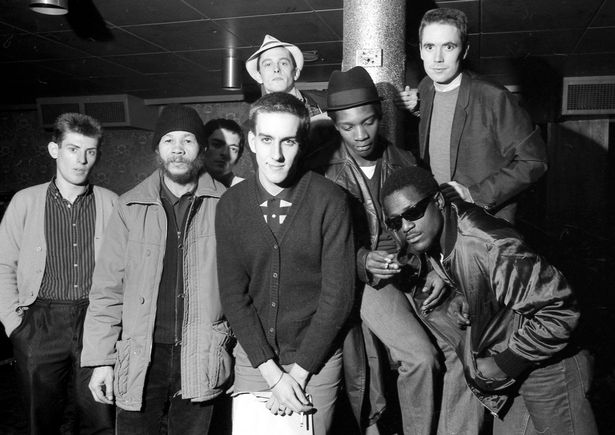 |
| Terry Hall, center, with The Specials and Rico (Image: Coventry Telegraph) |
(By Steve Shafer)
The news of Terry Hall's death on December 18 at age 63 from pancreatic cancer landed like a sucker punch to the gut--and I've been wrestling with how to process and write about it ever since. Several wonderfully insightful pieces about Hall's music and life already have been published--including Alexis Petridis' "Terry Hall was the self-assured eye of the Specials storm" in The Guardian and Neil Kulkarni's "Coventry & A Spirit Of Unbelonging: Terry Hall Remembered" in The Quietus. And Billy Bragg summed up Hall's and The Specials' impact so incredibly well in 280 characters. So, I'm not sure what I can add (but I need to add something).
As I write this, the terrible news of Pelé's death is just sinking in. I had seen him play at Giants Stadium in the Meadowlands in 1977 when I was 11, during his final season with the Cosmos. I've always considered it to be one of the highlights of my life, to have witnessed the greatest soccer player of all time in action, even if past his prime. While I'm reluctant to admit it, it's hitting me harder than Hall's passing--and forcing me to realize that I've always held Terry Hall at a bit of a distance, though I shouldn't be.
Even though he was the phenomenal, irreplaceable voice of my beloved Specials, Hall's dour and perpetually acerbic (though often bitingly funny) public persona left me cold. He was someone who could put anyone in their place with a quick, cutting remark. A man of few words, but they always hit their mark. I've always been wary of and felt at a disadvantage interacting with people this quick and sharp. (I have to mull things over--and often take longer than I'd like to admit to sort out the truth of a situation and articulate my thoughts.)
Having said all that and without ever having met him, I can immediately relate to several aspects of Hall's life and death. For several years after college, I worked as a caseworker at a residence for people with chronic mental illness (much later in his life, Hall was diagnosed as suffering from bipolar disorder). About five years ago, I witnessed a friend of mine--only a few months younger than me--undergo grueling treatment and slowly die from pancreatic cancer. And I've been a devoted fan of The Specials ever since first hearing "Ghost Town" in 1981.
Hall's detached and dispassionate vocals--often delivered standing stock still while the rest of the band exploded in furious motion behind him (as Petridis points out, see the closing credits of Dance Craze)--and fuck-all attitude made him the perfect frontman for The Specials, whose songs were mostly about how adults and their institutions had largely failed their generation. His disaffection with the world was not a pose. Growing up, he was subjected to one of the most horrific betrayals of adult trust imaginable.
At age 12, Hall was kidnapped by a teacher on a school trip in France and sexually abused by a pedophile ring for four days before being punched in the face and discarded on the side of a road. The trauma Hall suffered triggered a deep depression, whose treatment left him addicted to Valium for years and housebound for months (he also dropped out of school when he was 14). Hall also likely experienced emotional numbing--an unconscious psychological defense/survival mechanism common to people who have been severely traumatized where the brain attempts to lessen the pain by dampening all emotions (leaving someone who seems distanced, detached, and unfeeling).
It's not a stretch to argue that this abduction and sexual assault--in addition to his experience of growing up in a decaying, unfashionable Coventry in the 1970s (see Kulkarni's piece above)--lent Hall's voice and stage presence a unique authority and authenticity. In his alienation, cynicism, and emotional remove lay his power as he sang about everything around him--endemic racism and racial violence; working-class youth denied opportunity, purpose, even a satisfying night of fun by a government that didn't give a damn about their future; and the shared constant dread of all life being wiped out in a nuclear war. But his detachment didn't mean that Hall didn't care deeply about how the litany of society's unaddressed and intentionally aggravated ills was impacting Britain's youth. He was just clear-eyed about their plight. And everyone loved him for it.
Two of The Specials' greatest songs that bookend the original band's brief existence--Dammers' "Nite Klub" and Hall's own composition "Friday Night, Saturday Morning"--are both about the inability to take pleasure in a night out on the town. In "Nite Klub," Hall's deadpan delivery of the lyrics "I'm a parasite/I creep about at night" is spectacularly ambiguous. Is this meant to be sarcastic, commenting on the establishment's view of working-class youth on the dole? Or has the narrator internalized mainstream society's low opinion of him and his lot? And the suddenly released white-hot anger in the last line of this verse is devastating: "I don't work/'Cause I don't have to/I don't have to work/There's no, no work to do!" How can you have fun (or be a productive member of society, for that matter) when your life's going nowhere?
The narrator of "Nite Klub" is still hitting the nightspots a few years later in "Friday Night, Saturday Morning," but the piss and vinegar in his belly is gone. It's all now bleakly rote. Hall's unembellished singing conveys the track's boredom, futility, and despair extraordinarily well. But this portrait of Britain's forsaken youth is drawn with great empathy, not self-pity or anger at the powers that be (though Thatcher's the subtle target). And Hall's song contains one of the most universally relatable--and bluntly heartbreaking!--lyrics in pop music history: "Wish I had lipstick on my shirt/Instead of piss stains on my shoes."
In a 2019 interview with Richard Herring’s Leicester Square Theatre Podcast, Hall stated:
While there's much to unpack here (the forgiveness, his resilience), Hall's observation that child sexual abuse is "like part of life" is shocking. But considering what took place in the Catholic Church worldwide for decades--and god knows in how many other institutions that dealt with children--he's not wrong, is he?"I find it quite easy to forgive and forget. It’s like, you know, going back to my abduction, it’s like you can let that eat away at you but then well you know it’s paedophilia and it’s like part of life really."It’s unfortunate it happened to me but you can’t just let it destroy your life, it’s not good."
Clear-eyed to the end.
+ + + +
I offer my deepest condolences to Terry Hall's family, bandmates, friends, and fans.
+ + + +
(Updated on 1/3/2023 to include information on emotional numbing.)
+ + + +
Thursday, October 6, 2022
Shots in the Dark: The Adjusters "Otis Redding Will Save America"

(Appreciation by Steve Shafer)
The Band: The Adjusters, an overtly left-wing, mod-ish ska-soul band from Chicago who were heavily influenced by The Redskins (anti-fascist, socialist soul-rockabilly-punk skinheads, who released several singles and one classic album, Neither Washington Nor Moscow) and Billy Bragg (anti-fascist, socialist folk-punk rocker who still endeavors to write protest songs that are about both the personal and political, and has released a host of singles and albums, including my favorite Talking to the Taxman About Poetry, which sports the best-ever critique of Reagan's Cold War-era USA: "Help Save the Youth of America" (some of which is terrifyingly relevant again*)). This interracial, mixed-gender band was composed of Daraka Larimore-Hall (who is half-Jamaican) and Jessica Basta on vocals, Jason Packer on guitar, Matt Parker on organ/piano, Rench on drums, vocals, and samples, and Joshua Thurston-Milgrom on bass.
The Sound: The Adjusters' incendiary 1997 debut Politics of Style (Jump Up Records) veers between Stax soul, JB funk, rootsy reggae, and traditional (not 2 Tone) ska. Their 1998 follow-up on Moon Ska Records Before the Revolution (produced by Victor Rice) further refined the formula to greater effect with an even better collection of tracks (full disclosure, when I was at Moon Records I worked with the band promoting this record). 2003's Otis Redding Will Save America (blessed with a mind-blowingly good co-production by Rice and Rench) blended hip-hop, Big Beat, and trip-hop into the mix for a searing and unblinkered look at America in the years just before and after the Twin Towers fell.
The Release: The writing, recording, and mixing of The Adjusters' Otis Redding Will Save America straddled one of the most dramatic paradigm shifts in American history: the immediate pre- and post-9/11 years. The relatively peaceful and prosperous Clinton '90s wound down with an absurd impeachment over lying about sex (and we didn't fully comprehend the portents of the 1993 World Trade Center attack and 1995 Oklahoma City bombing and how they would shape the next two decades). The first dotcom bubble burst and the Y2K freakout was (thankfully) a bust.
The George W. Bush years started badly with an election swung his way by the right-wingers on the Supreme Court and only went down from there. After apparently ignoring our intelligence service's red alert signals about the coming terrorist attacks, Bush led the nation into a particularly nightmarish and tragic period in the USA following 9/11. It all culminated in the appalling--and completely unnecessary and unprovoked--2003 Iraq War (that eventually killed around 4,500 American servicepeople, tens of thousands of Iraqi insurgents, and around 600,000 Iraqi civilians). Even as it was all unfolding back then, it was obvious that the George W. Bush Administration was lying that Iraq had weapons of mass destruction and that Saddam Hussein was behind the 9/11 attack. They simply wanted to justify a preordained invasion of that country (when it was likely that elements within the Saudi government helped the al-Qaida terrorists carry out their mission).
The 9/11 attacks did more than murder several thousand Americans. They shook us to our core and unleashed our darkest impulses in our so-called War on Terror--leading us to abandon our laws and values to assuage our security fears and nurture our lust for revenge. And our country did more to destroy itself and betray everything that America purports to stand for than 12 hijackers could ever dream of accomplishing.
(Just as a reminder, here are some of the appalling lowlights of our War on Terror: the torture--and waterboarding is torture--and indefinite detention of suspected terrorists; the use of extraordinary rendition; the illegal monitoring and wiretapping of Americans' e-mails and phone calls under The Patriot Act; the profiling and quasi-legal surveillance of American Muslims; the "unitary executive" theory and use of Presidential signing statements; the Bush Administration's deliberate misinterpretation and shredding of our nation's laws; and does anyone remember that insane psych-op weekend when Americans across the country freaked out after the White House suggested that Americans buy duct tape and plastic sheeting in case of a dirty bomb/bio-chemical attack?)
The Adjusters believed that America--which has never quite lived up to its promise in the Declaration of Independence that all people are created equal and have the right to life, liberty, and the pursuit of happiness--had not only lost its shit but had badly lost its way.
While the band was recording the album in Version City's spartan basement studio on East Third Street in Manhattan, one of the band members visited the restroom of the bar upstairs and noticed something written on the toilet stall wall (in what would become their own Smells Like Teen Spirit moment): Otis Redding will save America.
Eventually, The Adjusters realized that this phrase encapsulated everything they were trying to convey with this album. Otis Redding, the "King of Soul," had attempted to goad America into locating its conscience as it staggered through one of its most turbulent, violent, and hate-filled decades. He was one of the first Black soul singers who broke through to the white rock audience (see this video from the '67 Monterey Pop Festival) as an undisguised, undiluted, and unbowed Black man (in the 1960s, Black men accepted within white pop culture usually weren't permitted to be regular human beings who could express, or be the overt object of, sexual desire--see the constraints placed on Sidney Poiter by Hollywood). This was at a time when America was forced to come to terms with its white supremacist/Jim Crow legacy and recognize and support the equal/legal rights of Black American citizens; endure a string of devastating political and racial assassinations (JFK, MLK, Jr., RFK, Malcolm X, Medgar Evers, and many lesser-known Civil Rights martyrs); and muddle through an unwinnable, imperialistic proxy war with China and Russia in Vietnam that killed 58,200 young US soldiers (average age: 23) and millions of Vietnamese.
To give some context to Redding's extraordinary and unprecedented impact on American society, check out this appreciation in The New Yorker: "Marching in place to keep pace with the beat, pumping his fists in the air, striding across stages with a long-legged gait that parodied his “down home” origins, Redding’s confident yet unaffected eroticism epitomized the African-American ideal of a “natural man.” White audiences of the time had never seen anything like it. The effect was so powerful that Bob Weir, of the Grateful Dead, said, of Redding’s performance at the Monterey Pop Festival, "I was pretty sure I’d seen God onstage"...In the way he looked and the way he sang and the way he led his tragically unfinished life, this princely son of Georgia sharecroppers was a one-man repudiation of the depraved doctrine of "white supremacy," whose dark vestiges still contaminate our world." (After over 4,000 documented lynchings of Black Americans from 1877 to 1950, the US finally has the Emmitt Till federal anti-lynching bill on the books, which was signed into law by President Biden and defines lynching as "a hate crime that results in death or serious bodily injury.")
To heal the nation, Redding pleaded with everyone to "try a little tenderness," which isn't just about relations between the sexes. The country needed (and still needs) heaping doses of empathy for white America to see Black Americans as their fellow human beings. But Redding also insisted that respect be shown to Black citizens in his hit song transformed into an early feminist and Civil Rights anthem by Aretha Franklin. Notably, Redding's posthumous hit "Dock of the Bay" underscored the loneliness and aimlessness of being rejected by the society that birthed and (reluctantly) fostered you.
While Redding never finished his journey (he died in a plane crash at age 26 along with most of the members of his backing band the Bar-Kays), his music and insistence on being his unreserved self in public on stage offered the hope that America could be a pluralistic society that embraced diversity and recognized everyone's rights equally.
For Otis Redding Will Save America, The Adjusters expanded their sound to further explore/honor Black American music beyond their mod-ska-soul mix and incorporated hip-hop and its musical descendants filtered through British subculture: trip-hop and Big Beat (Lionrock's "Rude Boy Rock" and Sly and Robbie's Drum & Bass Strip to the Bone by Howie B influenced this record enormously). Of course, practically all American popular music was created by Black American musicians: jazz, blues, R&B, soul, rock 'n' roll, and hip hop (Black music is one of the United States' most powerful cultural exports and a primary driver of our entertainment economy). And The Adjusters were about celebrating Black American music.
This expanded musical palette may have been a bridge too far for hard-line ska fans, but The Adjusters never comfortably fit within the confines of the '90s US ska scene, which skewed more towards punk rock (it's worth noting that in its original '76-'77 incarnation, punk stripped rock 'n' roll of its Black origins in R&B and gospel). And The Adjusters' overt democratic socialist stance and political activism through Modern Action and the Democratic Socialists of America was sometimes a sore point among the reactionary, almost libertarian (barf) elements of the ska fan base (even though some of our country's most popular social and educational programs--Social Security, Medicare, Veterans Administration, public schools, public universities, public libraries--are all socialist in nature). But The Adjusters never cared about discomforting the comfortable and privileged (see Daraka's comments about the 1998 Ska Against Racism Tour in the Chicago Reader**).
Like The Specials, The Adjusters wanted their music to move your body and their message to stimulate your mind. So, Otis Redding Will Save America is equal parts party soundtrack and political rallying cry--both essential for surviving desperate times. And it's one of the best albums that the '90s ska scene ever yielded.
Otis Redding Will Save America opens with "WTF Ska" an old school-sounding tune that's laid over a decidedly new school drum loop (this ain't downtown JA!). It's the instrumental version of "When Things Fall," which appears later on the record and is an appeal for solidarity across race and class lines in the face of injustice and adversity--and pretty much sums up the theme of the entire album. The Adjusters' superb and powerful cover of Gil Scott-Heron's "Gun" is about the fraying of the social contract (to the point where every one of your fellow citizens is a potential threat) and a society where violence and killing are both way of life and entertainment.
Everybody's got a .45
And the philosophy seems to be
At least as near as I can see
When other folks give up theirs, I'll give up mine
This is a violent civilization
If civilization's where I am
'Cause every channel that I stop on
Got a different kind of cop on
Killing them by the million for Uncle Sam
But Saturday night just ain't that special
Yeah, I got the constitution on the run
Yeah, 'cause even though we've got the right
To defend our home, to defend our life
You got to understand to get it in hand about the guns
"Can't See the Light," an original, traditional-sounding rocksteady cut (that features Dr. Ring Ding), is about being comfortably numb and disconnected as the world burns around you--and refusing to take sides or even recognize right from wrong (and alludes to The Clash coming to terms with reality with this lyric: So safe and warm in your nice suburban home). "Master Blaster" is, of course, a Stevie Wonder cover. It's his 1980 reggae tribute to Bob Marley that incorporates part of "Jammin'" and celebrates Zimbabwe's hard-fought independence from their colonial British overlords and Black self-determination, in general (Jessica Basta takes lead vocals here and really shines).
Sounding like a lost Public Enemy cut from It Takes a Nation of Millions to Hold Us Back, "If You" is an extraordinary and wickedly fierce hip-hop track featuring the mighty T.O.N.E. on vocals and built on a sample from Wagner's "Ride of the Valkyries" (most famously used during a brutal attack on a Vietnamese village just after the "Charlie don't surf scene" in Apocalypse Now). It offers sharp commentary on how bringing about real change demands so much more than performative gestures.***
If you're sick of seeing Black people gettin' shit
Raise your fist (raise 'em up, raise 'em up)
And if you're sick of seeing women gettin' hit
Raise your fist (raise 'em up, raise 'em up)
And if you're sick of seeing poor people gettin' dissed
Raise your fist (put 'em up, put 'em up)
And if you wanna do something 'bout it
You gotta do more than raise your fist to get pissed
The downbeat "Monkey Hate Reggae" is about a disaffected youth in a no-future rust belt town coming under the sway of a "right-wing libertine" and acting out violently as a result (shades of "Clampdown"). The ebullient "The Fightback, Part II" revisits and amps up this funk-powered Before the Revolution track, but recasts its lyrics to laud the massive antiglobalization protests at the 1999 World Trade Organization's meeting in Seattle ("Corporations split the world in two/Which side, which side for you?...You can't fight the man alone/Fuck with the people and the people fight back").
The instrumental booty-shaking dancefloor-filling portion of Otis Redding Will Save America is a collection of genre-bending trip-hop tracks packed with elements of reggae, funk, and hip-hop, plus samples galore (this entire album features some seriously deep grooves and crazy, next-level rhythms thanks to secret weapon Rench). The awesome "Mumia in Tibet" (which refers to Mumia Abu-Jamal) is like a drum 'n' bass mash-up with something off Jump With Joey's Ska Ba. "Boomstick" borrows Musical Youth's intro to "Pass the Dutchie" ("This generation...rules the nation...with version!") for this fantastic percussive workout. And "Supergoodlookin" brings the funk for when you want to get down and funky ("...take it home if you like it/Finger-licking good/Take it home if you like it").
Otis Redding Will Save America concludes with the sobering reality of "It's Like That." The struggle for equality and social/economic justice is far from over and must continue at all costs, despite people's apathy and the considerable power of the forces perfectly happy with/exploiting the status quo: "Can't tell the rich man to stop scheming/But we can change this shitstem/If only we look past the horizon...You may not feel the situation/But give it a generation/It's not gonna look good to my grandchildren."
The Ugly Reality: The Adjusters' Otis Redding Will Save America was released just a few years after the ska meltdown at the end of the 1990s when the scene was abandoned by the wannabes and driven/shamed back underground. So, the audience to enjoy it and the scene infrastructure to promote it was largely gone. And it didn't help that Otis Redding Will Save America was only available as an import from Grover Records in Germany. Right after The Adjusters finished recording the album, Moon Ska went under (on December 17, 2000), but Bucket was kind enough to release the unmixed masters to the band so they could finish and issue the record elsewhere. After the album was released by Grover, plans were in place to tour Europe in support (Daraka was living in Norway at the time and other members of the band took leave of their jobs or quit), but everything was canceled at the last minute. The band broke up as a result--and none of the tracks on Otis Redding Will Save America were ever played live.
It's also incredibly ironic that an album about the battle for America's soul has never been released domestically. But perhaps worst of all is that these songs about racism, hatred, inequity, gun violence, and the longing to change the power structure of our economy and political system are still painfully relevant almost 20 years later, maybe even more so now than they were in 2003.
+ + + +
Notes:
* I happened to catch Billy Bragg at The Beacon Theater on his brilliant first tour of North America in 1984 opening for Echo and the Bunnymen during their magnificent Ocean Rain tour.
** [From the Chicago Reader's "Ska's Lost Cause" article:] "The Adjusters’ Larimore was more skeptical. “Not talking about racism as a system, or racism as something that you should be actively fighting against, but talking about it like, ‘You shouldn’t be mean to black people,’ is just ridiculous,” he said. “It’s like the 2-Tone take on racism, which in the 2-Tone context meant something completely different. There you had a racially diverse scene where people were beating each other up, so going out and saying ‘Hey, don’t beat each other up’ was a progressive thing and part of the more socialist agenda of the people behind 2-Tone. But going to a ska crowd that’s 99 percent white and pretty solidly liberal–especially on race issues–and saying ‘Don’t beat up black people’ is like going out and saying ‘Don’t molest children.’ They might as well do Ska Against Incest.”"
*** Here are some of my favorite verses from "If You" worth quoting here:
If I'm a villain
Let's love the penicillin
I'm not sick with crimes
I'm sick with rhymes
New gang bang
I bang slang for fame
Guiliani, ha!, punany
The same thang...
And
Smiling faces lyin' to the races
You got a facelift, but you're still a racist
You might like your blunder
My hatred alone will rend you asunder
I've got a mind to triumph my will
Look in my eyes, got expression to kill
Syllogisms for your fascisms
You won't find me in your high-tech prisons
Damn!
+ + + +
Much thanks to Daraka Larimore-Hall for filling in a few of the blanks and providing several corrections.
+ + + +
Friday, June 10, 2022
Duff Review: Victor Romero Evans "At the Club" b/w The Detonators "Lift Off" reissue

12" vinyl single
Special Request
1980 (2022 reissue)
(Review by Steve Shafer)
Remastered and reissued for the first time since 1980, the John Collins-produced/co-written 12" single featuring Victor Romero Evans' "At the Club" and The Detonators' "Lift Off" should be of interest to Specials' fans, as it's forever linked to their most brilliant release--the Ghost Town EP.
Back in the day, after the Evans/Detonators record was played on Radio One's "Roundtable" program and favorably reviewed (it also was #1 on Black Echoes' reggae chart at the time), Collins received a late-night call from Jerry Dammers asking him if he might be interested in producing The Specials' next recording. The band was very impressed with Collins' production (recorded on a four-track in the front room of his house and released on his own label) and, in the wake of More Specials' not completely welcome excursion into muzak/lounge and the hi-tech 24-track studio it had been recorded in (that offered Dammers too many choices!), The Specials wanted to capture a more authentic reggae sound for these new songs in a much simpler fashion. And they believed Collins was their man.
When The Specials' met John Collins, they didn't expect him to be white. Lynval Golding and Neville Staple told him, "We were expecting someone like Lee Perry; a wild rasta smoking ganja." Indeed, the seductive Lovers Rock of "At the Club" and mysterious outer space dub of "Lift Off" seem as if they could have come from the mixing desks of Dennis Bovell or Mad Professor, two of the top UK reggae producers back then--and now. (Trainspotters will be interested to know that Victor Romero Evans also played the part of Lover in Franco Rosso’s stellar 1980 film Babylon--an updated Thatcher-era The Harder They Come shot in South London, with a boss reggae soundtrack by Bovell, Yabby U, I-Roy, Cassandra, Aswad, Vin Gordon, and Michael Rose.)
Of these two tracks, the wonderful dub instrumental "Lift Off" is clearly the sonic blueprint for what Dammers wanted for "Ghost Town." It sports a clean, warm, roots reggae sound with electro percussion and trippy synth effects (shades of every B 1950s sci-fi film you've ever seen)--and features the same ghost synth that is later used to open and close "Ghost Town." (To these ears, John Bradbury's drumming on "Ghost Town" and "Friday Night, Saturday Morning" sounds like its programmed, even though it's not; but I think it's a combination of how Brad is drumming--reportedly influenced by Gregory Isaacs' "Night Nurse"--and how Collins recorded him.)
Specials' completists will want to snap up a copy of this (I ordered a copy through Juno.co.uk), but the Victor Romero Evans "At the Club"/Detonators "Lift Off" 12" is worth having in its own right. It's a fantastic slice of early '80s UK reggae that stands the test of time.
+ + + +
Monday, June 6, 2022
Duff Review: Norwood, Angelo, and Chris Meet Eric Blowtorch and the Bodyguards "Too Many Dues" b/w Eric Blowtorch and the Bodyguards "Mercy"

Bopaganda! Records & Tapes
2022
(Review by Steve Shafer)
Fishbone's 1988 masterpiece Truth & Soul was largely an exposition on what it was like to be a Black American living in an unrelentingly racist America (see most of Truth & Soul's side two: "One Day," "Subliminal Fascism," "Slow Bus Movin' (Howard Beach Party)," "Ghetto Soundwave," and "Change"). When the album was recorded, a lot of the good that had resulted from the brutally hard work of the Civil Rights Movement and America's attempts at building an equitable and just Great Society was being rolled back during the regressive Reagan '80s. "Slow Bus Movin' (Howard Beach Party)," in particular, was written and recorded in response to the horrific 1986 death of New Yorker Michael Griffith, who was hit and killed by a car as he attempted to cross the Belt Parkway in Queens while fleeing a mob of white teenagers trying to attack him (acts of racial terror didn't only happen in the Jim Crow South). According to The New York Times:
"The events in Howard Beach began when Mr. Griffith, a construction worker, and three black companions traveled from Brooklyn to Queens to pick up his paycheck. Their car broke down late on Dec. 19 on a desolate stretch of Cross Bay Boulevard, and three of the four began walking into Howard Beach. As they were crossing the street, they were nearly bumped by a car in which several white teenagers were riding. Racial slurs were exchanged. The teenagers, joined by other young whites, confronted the black men outside a pizza parlor, New Park Pizza, and chased them.
Timothy Grimes, who was 18, escaped unharmed. Mr. Griffith was killed by a car on the Belt Parkway. Cedric Sandiford, who was 36, was beaten with a bat and other weapons...
...Jon Lester, Scott Kern and Jason Ladone were convicted of manslaughter and assault."
Flash forward 30+ years later and--while some things have changed for the better--much has not. Members of Fishbone (Norwood Fisher, Angelo Moore, and Chris Dowd)--plus Eric Blowtorch and the Bodyguards--still feel compelled to write and record songs about America's unrelenting racism and its abuse and murder of Black people. The terrific "Too Many Dues"--co-written by Eric Beaumont and Norwood Fisher--is an ironically chipper ska/jump blues cut that conveys some real anguish over the high profile murder of Breonna Taylor and permanent disabling of Jacob Blake (10% of the single's profits are being donated to Black Lives Matter). But it's also about the tragic inability of America to live up to its ideals and treat all people equally in every aspect of life--and under the law (we fought a bloody civil war over it and amended the Constitution several times in attempts to do so).
"Breonna Taylor was a healer, but the jailer
Just had to invade her, viciously assail her
Every, every day here to the cross we nail her
The great experiment is a failure
What does a brother have to do
To reap respect already due
To stop the spiteful spew
To not be turning blue?"
On the flip side is the excellent 2 Tone-ish ska track "Mercy," which is a plea for the salvation of humanity, a mantra for our thoroughly horrific times, particularly in these fragmented United States of ours: "Mercy in destabilizer stormtroop’s face/Mercy, mercy when your blood boils over/Mercy to the driver in the bulldozer." It's a mournful track, like something off the Ghost Town EP, but interspersed with joyous and hopeful funk-soul breaks in the choruses. And it's protest music that's not about casting blame, but searching for something that can heal what's broken inside of us, so we won't be at each other's throats, and might even be able to begin to start caring for one other again.
+ + + +
Wednesday, January 19, 2022
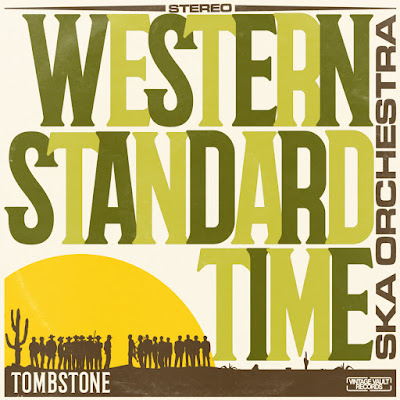
Duff Review: Western Standard Time Ska Orchestra "Tombstone"
LP/digital
2021
(Review by Steve Shafer)
After releasing two Skatalites tribute albums, the magnificent Western Standard Time Ska Orchestra--an incredibly gifted platoon of ska and jazz musicians led by Eitan Avineri (The Allentons)--have finally recorded an album of their own ska-jazz-big band originals (mostly written by Avineri), plus one Chris Murray cover that's been part of their live set for several years now. And, boy, it's been worth the wait. Tombstone is packed with memorable songs, features impeccable and compelling performances, and is one of the best sounding ska records in recent memory. It's a class album from start to finish.
As its title and cover art suggest, Tombstone has a loose Hollywood Western movie theme to it. Lead track "Monolith Ska" is one of several dramatic widescreen cinematic cuts (also see "Naftuli")--music that can fill the vast expanse of Monument Valley (featured in many of John Ford's Westerns), while "Tombstone" (which sounds a bit like The Specials "Vote for Me" in parts) has some menace to it, which is appropriate, since it was the location of the notorious Gunfight at the O.K. Corral (John Ford made a movie about it, too: My Darling Clementine). "Nostalgic Ska" is bright and chipper; "Grizzly Ska" is majestic; "Fortified" is a lovely jazzy reggae cut that could have come off Ernest Ranglin's Monty Alexander-produced Below the Bassline album; and "Sunrise from the East" is an awesome spaghetti Western ska track via the Far East.
Interestingly enough, the two cuts that don't really fit in with the theme of the album--but are great, nonetheless--are the two vocal cuts. Having said that, they're both about picking yourself up when you're in the dumps and seizing the fleeting day. It's wild to hear Chris Murray as a crooner fronting a big band singing "Moment" from his album Raw (key verse: "Hope and dreams are what we're made of/And those dreams should never die/It was given, this reason for living/Each moment the present no future can buy"). And we veer into Dean Martin/Rat Pack territory with "Habit of Happiness," co-written by The Aggrolites' Jesse Wagner and Avineri. Wagner urges the listener to rewire their brain to help survive this insane ride we're all on:
When the times, they seem tough
And you feel you've had enough
You give up and say there's nothing else that's left
To do
Oh, that ain't you
Let there be
An extraordinarily
Create that habit of happiness!
Western Standard Time Ska Orchestra's Tombstone is one of the best ska albums released in 2021, and will be high up on ska fans' playlists for years to come.
+ + + +
Monday, October 25, 2021
Duff Review: Various Artists "Disco Reggae, Volume 4"
 |
| This is not a Trojan comp. |
(Review by Steve Shafer)
Disco Reggae, Volume 4 (LP/digital, Stix Records/Favorite Recordings, 2021) is the latest in this series of similarly-themed compilations from this French label and its orbit of French producers (and is a great companion record to the recently released, Don Letts-selected Version Excursion for Late Night Tales, which I reviewed here). Disco Reggae, Volume 4 is a sweet mix of dance floor rump shakers, Quiet Storm slow-dancers/make-out tracks, and afterparty cool down cuts.
Side A doesn't quite get the balance right. While excellent cuts in their own right, Taggy Matcher's cover of Chemise's "She Can't Love You" and Blundetto Meets Booker Gee's read of Tyrone & Carr's 1973 song "Take Me With You" lean heavily disco, with very little reggae to speak of. Having said that, Soul Sugar's take on Roy Ayers' 1972 Afrocentric/Black empowerment soul-jazz track "We Live in Brooklyn, Baby" sounds a bit like Mad Professor meets Massive Attack (I've been listening a lot to their stellar Part II/Mezzanine Remix Tapes '98 lately); and Wolfgang's fantastic "Summertime" marries a Casio-like percussive track (shades of The Specials More Specials) to a roots reggae/trombone-focused interpretation of this Ira and George Gershwin jazz standard from Porgy & Bess.
The flip side of Disco Reggae really nails it with Mato's infectious, groovy cover of A Taste of Honey's 1978 world-wide hit "Boogie Oogie Oogie"; and Hawa's version of Keni Burke's 1982 cut "Risin' To The Top" (which here seems like a cousin to Lovers Rock) even incorporates a bit of the Mary Jane Girls' super-steamy "All Night Long" (which originally borrowed the bass line from "Risin' To The Top"!) While more disco reggae-adjacent, Taggy Matcher's awesome take on Kraftwerk's "Radioactivity" marries the Germans' electronic/synthpop melody to a much-needed propulsive reggae skank (the original's pretty stiff). If you're rigid in your musical tastes, this may not be for you--but if you're into a bit of genre-bending/blending, Disco Reggae, Volume 4 delivers the goods!
+ + + +
Wednesday, October 20, 2021
Duff Review: The Specials "Protest Songs 1924-2012"
 (Review by Steve Shafer)
The Specials' new album Protest Songs 1924-2012 (CD/LP, Island Records, 2021)--their follow-up to 2019's excellent Encore (read my review here)--is a strange beast. It manages to be both a powerful and beautifully realized concept album and a huge sod off to their fans. Anyone who has faithfully supported The Specials through its various incarnations and diminishing ranks of original members, lo these 40+ years, is not unreasonably expecting some ska. But Protest Songs adamantly delivers none, though there's folk, blues, spirituals, soul, skiffle, rock, and post punk (having said that, I did catch a bit of ska rhythm guitar in "Listening Wind!"). What's odd is that as you listen through the tracks, it's quite easy to imagine at least some of them recast as ska or reggae songs. So, for whatever reason, the band--Terry Hall, Lynval Golding, and Horace Panter (plus Nikolaj Torp Larsen, Kendrick Rowe, Steve Cradock, Tim Smart, Pablo Mendelssohn, Jim Hunt, Michael "Bammie" Rose, Tony "Groco" Uter, and Hanna Hu)--opted to go in this direction, surely well-aware that it would dash fans' expectations and piss many of them off mightily.
Before the pandemic disrupted everything, The Specials had been planning to record a reggae album in Jamaica--and then the world-wide George Floyd protests erupted in the wake of Floyd's horrific murder at the hands of the police. So, they decided to record a covers album of protest songs in response (and one imagines that the resurgence of white supremacy and worsening cold civil war between Americans and seditious, anti-democratic forces in the US played a part, too), the majority of them by American musicians, as an interim project and to force them out of a post-Covid lockdown creative rut.
Once you set aside your disappointment regarding the absence of ska sounds (though the fact that these are protest songs is very much on brand), you may find that The Specials' Protest Songs 1924-2012 is a terrific album. The choice of tracks (with lyrics that pack a wallop), their interpretations, and performances are uniformly excellent. Some of the songs are direct in their messaging: The Staple Singers' "Freedom Highway" and The Freedom Singers' "Ain't Gonna Let Nobody Turn Us Around" are potent, raucous US Civil Rights Movement-era anti-racist anthems; Rod McKuen's "Soldiers Who Want to Be Heroes" ("...number practically zero/But there are millions/Who want to be civilians") is an anti-war earworm written before Vietnam, but reissued at its height, and relevant countless times since then; Frank Zappa's "Trouble Every Day," written in reaction to the 1965 Watts riots and decrying both the violence/looting unleashed in that neighborhood and ubiquitous racism that led to the social unrest; and Bob Marley's "Get Up, Stand Up" is a general call for solidarity in support of universal human rights--though this quiet, acoustic version sung by Golding seems like something one would pull in on shortwave radio while hunkered down in some secret hiding place as in The Clash's English Civil War. While others are more oblique in subject matter or less-known for being protest songs.
Everybody knows that the dice are loaded
Everybody rolls with their fingers crossed
Everybody knows the war is over
Everybody knows the good guys lost
Everybody knows the fight was fixed
The poor stay poor, the rich get rich
That's how it goes
Everybody knows
Malvina Reynold's children's folk tune "I Live in a City" seems like a weird choice, but it's a strong endorsement of urban solidarity and multiculturalism: "Brown hands, yellow hands, white and black/All together built this town" (take that, rural MAGA-Again-heads!). And Reynold's proud rejection of American dog-eat-dog capitalism, "I Don't Mind Failing in This World," is positively punk rock in attitude, even if it's delivered via gentle folk song:
I don't mind failing in this world
Don't mind wearing the ragged britches
'Cause those who succeed are sons of bitches...
...I don't mind failing in this world
I'll stay down here with the raggedy crew
'Cause getting up there means stepping on you, so
I don't mind failing in this world
...I don't mind failing in this world
Some people ride in a car so fine
While others walk on a picket line, so
I don't mind failing in this world
One of the cruelest injustices that Black American GIs faced after fighting fascism during WW II in Europe was returning to the US and being subjected to racist Jim Crow laws in their own country (the Nazis based their Nuremberg Laws--their racial purity edicts--and their "Final Solution" on Jim Crow and the American eugenics movement). Blues musician Big Bill Broonzy first recorded his song "Black, Brown and White" in 1947 about this and the general Black American experience with white supremacy (wryly sung here by Golding):
I helped build this country
And I fought for it too
Now I guess that you can see
What a black man has to do
They say if you're white, should be all right
If you're brown, stick around
But if you're black, oh brother, get back, get back, get back
I win sweet victory
With my plough and hoe
Now, brother, you tell me
Whatcha gonna do 'bout the old Jim Crow?
The inclusion of Talking Heads' incredible "Listening Wind" (from Remain in Light and used in The Americans) is an unusual choice--it's a Cold War-era anti-American imperialism cut from the point of view of a African freedom fighter planting bombs to drive out the Yanks from his country (singer Hannah Hu takes lead vocals here). I'm a little surprised The Specials' didn't work in a little of John Holt's "Man Next Door" into their version of Jerry McCain's "My Next Door Neighbor" (essentially a long rant about someone driving you mad by always borrowing all your stuff). Perhaps the most Terry Hall-ish song ever, the country lullaby "Fuck All The Perfect People" by Chip Taylor of "Wild Thing" fame--about prison inmates who have no agency while they do their time ("To sing or not to sing/To swing or not to swing/Hell fills up the silence like chalk on the wall")--was chosen as it "rails against all those people who are So. Damn. Right." (Hopefully, it's not a message to you.)
My imported red vinyl LP included an exclusive and exceptionally good 7" single containing their "Vote for Me" and a cover of The Valentines' "Blam Blam Fever," recorded live at Coventry Cathedral during the 2019 Encore tour. Admittedly, this helped take the sting out of the lack of ska on Protest Songs, but also reminded me of what was missing. One of The Specials' brilliant strengths has been their ability to offer up songs that make you both think and dance--their medium, 2 Tone, is also the message. But Protest Songs, as great an album as it is, obliterates half of that formula and may turn off a good portion of their audience as a result.
+ + + +
Friday, October 15, 2021
Duff Review: Mento Buru "Skalloween" EP
 |
(Review by Steve Shafer)
Just in time for what promises to be a close-to-normal Halloween comes a fantastic treat from Mento Buru. Their new Skalloween EP (Digital, self-released, 2021) contains two boss ska covers of novelty monster cuts from fellow sons of Bakersfield, CA, as well as a Spanish language version, and three choice dubs by Dubrobot. "Goo Goo Muck" is a 1962 garage rock single by Ronnie Cook and The Gaylads about a teenage vampire on the prowl for, um, blood (the sexual subtext is hard to miss) that was famously covered by The Cramps on their 1981 album Psychedelic Jungle. Mento Buru's revved-up version (replete with horror movie sounds) is completely winning--even the undead couldn't resist dancing to it! "(It's a) Monster's Holiday" is a 1974 country track by Buck Owen (and covered fairly recently by Reagan Youth) about repeatedly running into the classic Universal Studios monsters (Frankenstein, Wolf Man, Dracula), though there's no real danger--think Abbot and Costello Meet Frankenstein. Mento Buru keep their take light and fun--and very appropriately quote The Munsters theme towards the end before a "Nite Klub"-inspired outro. These tracks are worthy--and sure to be popular--additions to any ska Halloween party mix (see Hoi Polloi skazine's extensive 500+ track list!).
+ + + +
Sunday, August 15, 2021
The Specials to Release "Protest Songs 1924-2012" on September 24, 2021

The tracklist for Protest Songs 1924-2012 is as follows (with links to the original songwriter/performer's recording in parentheses):
1. "Freedom Highway" (The Staple Singers)
2. "Everybody Knows" (Leonard Cohen)
3. "I Don't Mind Failing In This World" (Malvina Reynolds)
4. "Black, Brown And White" (Big Bill Broonzy)
5. "Ain’t Gonna Let Nobody Turn Us Around" (The Freedom Singers)
6. "Fuck All The Perfect People" (Chip Taylor & the New Ukrainians)
7. "My Next Door Neighbour" (Jerry McCain)
8. "Trouble Every Day" (Frank Zappa with the Mothers of Invention)
9. "Listening Wind" (Talking Heads)
10. "Soldiers Who Want To Be Heroes" (Rod McKuen)
11. "I Live in a City" (Malvina Reynolds)
12. "Get Up, Stand Up" (Bob Marley)
The Specials have a short snippet of their cover of The Staple Singers' "Freedom Highway" up on their Facebook page (and it sounds quite good).
And you can pre-order the CD now from the Universal Music store (no word on when the LP can be ordered).
+ + + +
Friday, August 6, 2021
Duff Review: Jerry Dammers "At the Home Organ: Demos 1980-82 (Ghost Town & Theme from The Boiler)"
(Review by Steve Shafer)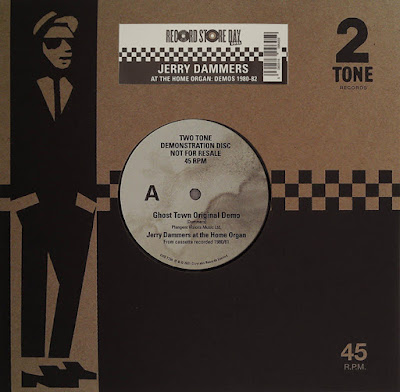
Issued in the UK as part of the second 2021 Record Store Day drop (cue the evergreen complaints about RSD), Jerry Dammers' At the Home Organ: Demos 1980-82 (10" vinyl single, 2 Tone/Chrysalis, 2021) is as advertised--these are his DIY instrumental demos of The Specials' "Ghost Town" and Rhoda Dakar with The Special AKA's "Theme from The Boiler" performed on his "home entertainment type organ." These recordings, mastered from their cassette originals (and which feature pretty good audio fidelity), are really for Specials completists, as there's nothing immediately revelatory here. Having said that, there's something wonderfully intimate and thrilling about hearing Dammers' playing this early, more muzak-y version of his masterpiece "Ghost Town" (think "Stereotype, Part 2"--yet it's also B-horror movie-sounding) that doesn't yet include the bright, major key "Do you remember the good old days before the ghost town?" bridge. We weren't ever meant to hear this--but it's fascinating to compare it to the studio recording and note how producer John Collins helped shape the extraordinary final product. And this demo of "The Theme from The Boiler" with John Shipley (The Swinging Cats, The Special AKA) on guitar is unexpectedly fleshed out and pretty fantastic. Since the bloodcurdling "The Boiler" was only meant to be heard once, this 45 is rarely pulled out to play. Which is a shame, as I've always thought that the studio version of "The Theme from The Boiler" is a superb and jittery dance floor-filling cut that should be spun frequently. Hopefully, this demo's inclusion will bring some renewed attention to this gem.
The paper label for At the Home Organ doesn't feature Walt Jabsco (the cardboard sleeve does), though it's designed to look worn and slightly mildewy, as if these faux demo-only singles were recently rescued from a forgotten box in a damp cupboard--a nice touch. As a Specials/2 Tone fan, I'm quite happy to have Dammers' At the Home Organ in my collection. Get 'em while you can.
+ + + +
Saturday, June 26, 2021
Duff Book Review: Lee Morris "2 Tone: Before, During & After"

After several decades marred by a dearth of tomes about 2 Tone apart from George Marshall's foundational and wonderfully opinionated The Two Tone Story (1990) and an extraordinary chapter about 2 Tone in Dick Hebdige's Cut 'n' Mix: Culture, Identity and Caribbean Music (1987), we're finally in a golden age of plenty. The spigot began to open in the late 2000s, with autobiographies from Horace Panter and Pauline Black, plus Paul Williams' superb biography of The Specials, You're Wondering Now. And more recently, we've seen coverage of 2 Tone in Heather Augustyn's terrific surveys of the genre, Ska: An Oral History and Ska: The Music of Liberation; amazing autobiographies from Ranking Roger (read my review) and Madness (read my review); and the best oral history of 2 Tone one could hope for in Daniel Rachel's Walls Come Tumbling Down: The Music and Politics of Rock Against Racism, 2 Tone and Red Wedge. (Oh, and I published The Duff Guide to 2 Tone in 2020, as well!)
To this crowded bookshelf, the discerning 2 Tone fan absolutely should add Lee Morris' book 2 Tone: Before, During & After (Paperback, Media House Books, 2020). Morris provides a comprehensive overview of every band that released music on the 2 Tone label (including the lesser-known, non-ska acts that were signed on the tail end of 2 Tone's existence, like Friday Club, The Higsons, and The Apollinaires), from their origins in the '70s up till the present day--and includes biographical sketches of all band members and key collaborators. (Plus there's a chapter on 2 Tone related bands, and if you ever make the pilgrimage to Coventry, info on the 2 Tone Trail.) Morris' book is crammed with details (and some welcome commentary) that help flesh out the entire 2 Tone story--and American fans, most of whom didn't have easy access to the British music publications breathlessly covering 2 Tone's rapid rise and prolonged flame out, will find it especially enlightening. I was particularly grateful for Morris' chapter on The Special AKA, since I knew too little of this band's history other than it's Phoenix-like rise from the post-Ghost Town ashes of The Specials; and that Jerry Dammers' perfectionism in crafting the magnificent In the Studio cost an ungodly sum, took forever to complete, and was so miserable an experience that Rhoda Dakar to this day has never listened to it.
2 Tone: Before, During & After is an essential and handy reference guide to the label--one that you'll be thumbing through for years to come (I certainly will be).
+ + + +
Friday, May 21, 2021
Duff Review: The Selecter "Too Much Pressure" Deluxe 40th Anniversary Reissue!

During their intense, year-long association with 2 Tone,* The Selecter always seemed to have been unfairly overshadowed in the press by their label co-directors and mates The Specials, despite that fact that The Selecter' original songs were as good (if not better) and relevant (addressing racism, street violence, alienation, and the "no future"/"nothing to do, nowhere to go" of Thatcher's England)--and their live performances just as incendiary. So, it's wonderfully fitting that of all the recent 2 Tone 40th anniversary releases, the deluxe reissue of The Selecter's debut 1980 album Too Much Pressure is by far the best.
The triple-CD deluxe edition of Too Much Pressure features the remastered version of the original album; a second disc of related singles, their 1979 John Peel session, and several previously unreleased recordings; a third disc of previously unreleased live tracks from two hometown concerts in Coventry from '79 and '80; and excellent, copious liner notes by Daniel Rachel (read my interview with him about this project), as well as track-by-track commentary by several members of the band (it should be noted that none of the other recent 2 Tone 40th Anniversary reissues were expanded and included unreleased material from the vaults). The heavyweight LP version of Too Much Pressure (mine is clear vinyl!) features a half-speed master, plus a copy of The Selecter's debut single "On My Radio" b/w "Too Much Pressure" (in the 2 Tone sleeve)--and if you ordered a copy from the 2 Tone store like I did, they included a 7" EP containing the four aforementioned live tracks from 1980 (the '79 concert will be released on vinyl during the second Record Store Day drop this summer). Die-hard Selecter/2 Tone fans will want--and be very pleased with--both editions.
The pairing of the Roger Lomas-produced "On My Radio" b/w "Too Much Pressure" single with the Too Much Pressure LP inadvertently underscores just how perfectly suited he was as The Selecter's producer. (First listen to the single and then the LP.) While Errol Ross did a very good job with producing the album, the tracks don't quite capture the power and punch of anything The Selecter recorded with Lomas (and there are many more examples of Lomas' work with them on the second disc of the triple-CD). At the time, according to Rachel's liner notes (and Neol Davies told me in an interview published in The Duff Guide to 2 Tone), the choice of Ross as producer was controversial within the band (Davies wanted Lomas, but more members of the band voted for Charley Anderson's friend Ross) and none of the band members were completely satisfied with the end results. So, Lomas was recruited again for "The Whisper" single and the band's sophomore LP Celebrate the Bullet--a very under appreciated album--read my write-up of it here. (The Specials had a similar issue with Elvis Costello's production for their debut album; he didn't quite capture the band's sound in the studio as well as Dave Jordan (More Specials) or John Collins (Ghost Town EP), which was evident when the bootleg Live at the Moonlight Club hit the streets prior to The Specials and the former made for a much better debut album--read my review of official 2 Tone/Chrysalis 2014 release of Live at the Moonlight Club here.)
Disc two of the CD set ("Singles, B-Sides & Rarities") contains a fantastic, previously unreleased, alternate (and more urgent) take of "Three Minute Hero" produced my Lomas for the band's lip-synched 1980 appearance on "Top of the Pops" (Errol produced the version released on the single). There's also an awesome, unreleased synth-washed version of "Cool Blue Lady" which was recorded by Lomas during "The Whisper" sessions (a second version of the track appeared on Celebrate). I learned from the liner notes that the superior version of "Street Feeling" on this disc that was included on the 12" of "The Whisper" was actually from the "On My Radio" b/w "Too Much Pressure" sessions (as Gaps said, "We recorded three songs and let the record company choose [what was on their first single]"). And rounding out the unreleased material on this CD is a brilliant medley/mash-up of Lee Perry's "A Live Injection," a bit of Tommy James and the Shondells' "Mony Mony," and "Too Much Pressure" recorded during a soundcheck in 1980. Plus, if you never got your hands on a copy of the "Ready Mix Radio" version of "On My Radio" done by Lomas and released as a freebie on flexi-disc for the first issue of Flexipop magazine in November of 1980, here's your chance to hear it (I have the flexi, but the track sounds loads better on CD).
The majority of live material on disc 3 of the CD set is from The Selecter's November 1979 concert at Tiffany's in Coventry, which was part of the UK 2 Tone Tour with The Specials and Madness. The Selecter had only been together for about six months at this point (and they were slated to start recording their debut album the next month), but their songs and performance are absolutely magnificent. Of course, it helped that most of the members of The Selecter previously had played together in other Coventry bands like Hard Top 22 and Neol Davies already had ace material that he written and performed ("On My Radio," "Out in the Streets," and "Street Feeling") with The Transposed Men (which included The Specials' John Bradbury and Desmond Brown). But still, it's extraordinary how good and confident and entertaining the band were so early in their existence.
One of the greatest stories revealed in Rachel's liner notes comes from their first recording session with Roger Lomas. The producer had seen them opening for The Ruts and knew that "On My Radio" was perfect for their debut single, but he didn't know the name of the track. When The Selecter played their set for him, but he didn't hear that hit song. So, Lomas asked if there was anything else and they responded "On My Radio," but they were reluctant to play it, because they thought it was like "a bloody Eurovision Contest song"!
This definitive edition of Too Much Pressure brilliantly documents The Selecter's enduring 2 Tone legacy. Get it!
+ + + +
(*They left 2 Tone for Chrysalis proper for "The Whisper" and Celebrate the Bullet releases.)
+ + + + +
Subscribe to:
Posts (Atom)


