Showing posts with label Byron Lee and the Dragonaires. Show all posts

Tuesday, November 3, 2020

Duff Guide to Ska Bullet Points: The Bartenders "Tańcz I Klaszcz" b/w "Cebron" and Capitol 1212 featuring Earl 16 "Love Will Tear Us Apart" b/w "Version"

(Reviews by Steve Shafer)
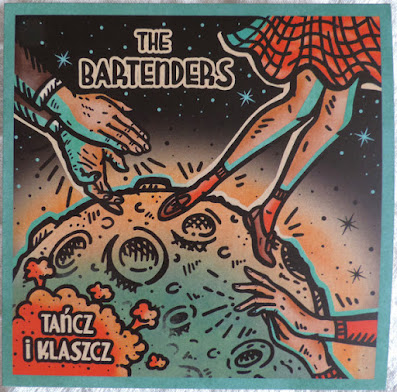
  • The cover illustration features a woman's legs dancing on the Moon with two sets of hands clapping.
     While The Bartenders' songs on their sensational new 45 "Tańcz I Klaszcz" ("Dance and Clap") b/w "Cebron" ("Onion") (Vinyl single, Bad Look Records, 2020) are sung in Polish--which might be a perceived barrier for some non-Polish speakers--their music is in the unmistakably universal (and accessible) language of ska. "Tańcz I Klaszcz" is a driving, Motown-like ska track that sure delivers on what's promised (commanded?) in the title/chorus (I wish I knew what was being sung about in the verses--it sure sounds like there's drama and heartbreak in there). In contrast, "Cebron" is a lovely and slightly mysterious jazzy ska cut with a great horn riff. This single is very much worth tracking down--be sure to keep The Bartenders on your radar.
On a side note, this year The Bartenders also released a tribute album to a fantastic all-female, pop, big-beat, and ska Polish group called Alibabki that was founded in 1963 and performed up through the late-'80s. Of note to Duff Guide to Ska readers, in 1965 they released the Jamajca Ska EP, which contained pop-ska originals (like "Echo Ska") and covers ("Wash Wash Ska," a version of Byron Lee, Keith Lyn, and Ken Lazarus' "Jamaica Ska"), and clearly had a big impact on The Bartenders. More recently, Alibabki released a postcard Flexi ska single backed The Bartenders called "Już Nie Twist."
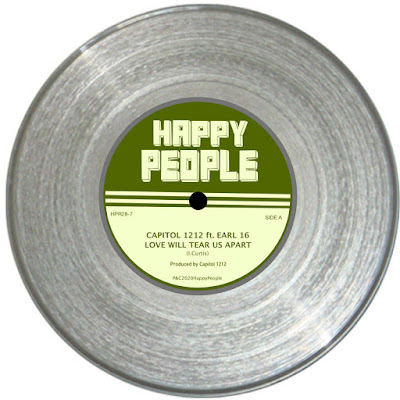
  • The paper label of the single features the name of the artist, the song title, and the imprint, Happy People Records.
     Joy Division's Ian Curtis was such an enormous fan of reggae that his bandmates, who formed New Order after Curtis' death by suicide in 1980, covered Curtis' favorite reggae track--Keith Hudson's "Turn the Heater On"--during their 1982 John Peel session for the BBC's Radio One (the EP of this session is very much worth obtaining). In fact, there's a lyric in Curtis' most iconic Joy Division track "Love Will Tear Us Apart" ("Why is the bedroom so cold?/You've turned away on your side...") that was no doubt inspired by Hudson's song ("Turn the heater on...Tonight/For I feel so cold at night/With you by my side will be all I need"). With this Ian Curtis--Keith Hudson connection in mind, it makes sense that a few reggae covers of "Love Will Tear Us Apart" already have been recorded (by Jäh Division and Italee), though Capitol 1212 featuring Earl 16's is the best I've heard by far. Originally released on the 2018 Scotch Bonnet compilation Puffer's Choice, Volume II, Capitol 1212 featuring Earl 16's killer roots reggae version of "Love..."--with echoey, almost jungle-sounding percussion that honors the original and gives what could have become too much of a dirge some life--is now available as a single with an exclusive dub mix on the B-side (Vinyl single/digital, Happy People Records, 2020). This version of "Love Will Tear Us Apart" checks all of the right boxes and then some for anyone who loves both their post-punk and roots reggae like I do.

Wednesday, September 30, 2020

Duff Review: "007 Licensed to Ska: James Bond and Other Film Soundtracks and TV Themes"

The cover features the title of the album within a stylized barrel of a gun (used in all of the Bond films); Don Drummond is featured in an inset photo playing the trombone.Soul Jazz Records
5 x vinyl single box set
2020

(Review by Steve Shafer)

While it was common practice for the original 1960s instrumental ska bands to cover popular songs and movie themes of the day, the James Bond connection to the Jamaican music scene was firmly cemented in 1962 during the filming of the first Bond film Dr. No, which was set on the island (as were Live and Let Die and The Man With the Golden Gun). Of course, Bond author Ian Fleming lived in Jamaica on an estate called Goldeneye, and he was the one who recommended future Island Records honcho Chris Blackwell to Dr. No's producers as a location scout and production assistant (the Blackwells were neighbors of Fleming, and unbeknownst to her son, Blanche Blackwell had a long-term affair with Fleming). Chris Blackwell, in turn, introduced composer Monty Norman, who had been hired to write the Dr. No soundtrack, to the "uptown" and more respectable Byron Lee and the Dragonaires (both guitarist Ernest Ranglin and trombonist Carlos Malcolm were in his band), who recorded the calypso-ish music on the movie soundtrack, and appeared in the film performing "Jump Up" (Blackwell apparently can be spied dancing in this scene, too).

In addition to the fact that the first Bond movie was shot in Jamaica, the stylish, womanizing, and legally transgressive Bond character resonated with many Jamaicans, as he was akin to the rebellious rude boy persona associated with toughs in the sound system scene (and street-level gangsters)--and celebrated/decried in the ska music of the early to mid-1960's (see Stranger Cole's "Rough and Tough," The Wailers' "Simmer Down," "Rude Boy," and "Jailhouse," Alton Ellis' "Dance Crasher" and "Cry Tough," Baba Brooks' "Gun Fever," Desmond Dekker "Rudy's Got Soul" and "007 (Shanty Town)," Derrick Morgan's "Tougher Than Tough" and "Cool Off Rudies," The Slickers' "Johnny Too Bad," The Valentines' "Blam Blam Fever," Prince Buster's "Judge Dread," Lee Perry's "Set Them Free," Dandy Livingstone's "Rudy, A Message to You," and dozens more).

In terms of risk management, since the better songs from movie and TV soundtracks already were well-known and liked, it made financial sense for budget-conscious record producers like Studio One's Coxsone Dodd to try to capitalize on their popularity by recording and releasing cover versions given a ska spin by some of the JA's best musicians (and they didn't have to solely rely on their roster of composers coming up with new material to record that may or may not sell). While most popular music is open to individual interpretation--we are free to associate whatever emotions and personal experiences we want to them (despite the songwriters' intentions)--these highly evocative and dramatic film and TV theme songs are specifically crafted to musically brand the traits of their particular fictional leads and frame their back stories. (To put it crassly, the theme songs are more sophisticated, bigger budget jingles to help sell movies instead of breakfast cereals.) Whenever I hear the opening guitar riff of the Bond theme, I'm thinking about how cool and sadistic Sean Connery is in that role, not what I was doing or how I feeling when I first heard it (and I don't even remember when or where I first heard it)--though listening to it always makes me feel cool and deadly like Bond. Within a matter of a few minutes, these theme songs aim to elicit specific moods and memories from listeners, calibrate their expectations for what this show or movie will deliver, and set the stage for all that is to transpire once the action starts. So, in this manner, popular theme songs often create uniform reactions (in terms of emotions and memories) across large groups of people that can be used and borrowed by others via cover versions.

For Record Store Day 2020, Soul Jazz Records collected many these now hard to find and pricey James Bond-related Studio One recordings (plus three others--hence the ridiculously long title of this release) in the superb and instantly collectable 007 Licensed to Ska: James Bond and Other Film Soundtracks and TV Themes 7" singles box set. Almost all of them feature Studio One's ace house band The Soul Brothers--Jackie Mittoo, Roland Alphonso, Johnny Moore and Lloyd Brevitt--who formed right after the dissolution of The Skatalites in the summer of 1965, and were joined by a rotating group of top JA musicians, including Bobby Ellis, Bryan Atkinson, Bunny Williams, Dennis "Ska" Campbell, Harold McKenzie, Harry Haughton, Jah Jerry Haynes, Joe Isaacs, Karl Bryan, Lester Sterling, Lloyd Knibbs, Lynn Taitt, Sam Wells, Vin Gordon, and Wallin Cameron. Dodd, naturally, was at the controls, producing all of these sessions. Notably none of these tracks are straight covers. They've been interpreted through a Jamaican ska-jazz lens by gifted musicians, who have utilized the widespread recognition and appeal of these movie and TV show themes, but transformed them into something new that they own--transmuting commerce back into art.

007 Licensed to Ska kicks off with The Soul Brothers' "James Bond Girl" (1966), a great minor-key Roland Alphonso original that captures the frisson in the sexual allure and possible menace the woman in this role presents to 007 during each mission, and nicely incorporates the John Barry/Monty Norman Bond theme in its intro and outro. It's paired with Roland Alphonso and The Studio One Orchestra's excellent ska-jazz take on "From Russia With Love" (1965) by John Barry and Lionel Bart (Alphonso has a sweet solo here).

Record two features a beautiful Jamaican jazz read of the instrumental version of John Barry's "Thunderball" by The Soul Brothers (the Keyboard King solos), which is backed with Mittoo's awesome 1969 keyboard-heavy reggae funk cover of Dominic Frontiere's "Hang Em High"--from the spaghetti Western-like revenge film of the same name (the track is clearly an homage to Ennio Morricone)--which appeared on Mittoo's Keep on Dancing LP.

"Mr Kiss Kiss Bang Bang" (1967)--Bond summed up in a nutshell--by John Barry and Leslie Bricuss is another instrumental cut from the Thunderball soundtrack (though there is a version with lyrics sung by Shirley Bassey). The Soul Brothers drain the schmaltz to reveal the cracking melodies hidden within that made for a perfect Skatalites-like ska track. The dark and wonderful "007" by The Soul Brothers is credited to Alphonso/Dodd/Mittoo, though some of its horn melodies may share some notes with Barry's "007," also from the Thunderball OST, but the song thoroughly sounds like it's theirs.

Lee Perry and The Wailers' terrific "Pussy Galore," a 1965 Dodd/Perry original, is a fairly conventional ska song with Perry's weirdness lurking beneath the surface, just itching to be released. Scratch warns the listener, "If you are rich and wanna get poor/Just fall in love with Pussy Galore" (the character, apparently based on Blanche Blackwell (!), appears in Goldfinger and is played by Honor Blackman, who was in the TV show The Avengers as Dr. Cathy Gale before Diana Rigg came on as Emma Peel). The Soul Brothers' jaunty "Mr. Flint" (1966) borrows Jerry Goldsmith's theme for the James Bond spoof Our Man Flint.

I never before realized that The Skatalites' incredible 1965 cut "Ball of Fire" (AKA "Echo Four Two") was composed by Laurie Johnson for the short-lived 1961 British police procedural Echo Four Two (Johnson famously wrote the theme to the TV show The Avengers). To this day, it stands as one of The Skatalites' best recorded performances. The set is rounded out with a rare lounge-y interpretation of Barry's "007" instrumental by The Soul Brothers retitled "James Bond Danger Man."

Hopefully, Soul Jazz Records will also release this collection as an LP someday, as something this good should be available to the ska massive, not just those lucky enough to come across this singles box set on Record Store Day. There's the potential for good commerce in making this art available to the masses.

+ + + +

Friday, March 6, 2020

Duff Guide to Ska Fast Takes: The Red Stripes "Made in Hong Kong"

The cover features a 1950s-style illustration of a boy and a girl playing a record on a turntable.Mod Sound Records
CD/LP/digital (available in the USA through Jump Up Records)
2020

Digital release: March 30, 2020
Vinyl release: April 6, 2020

(Review by Steve Shafer)

For their terrific second album Made in Hong Kong, The Red Stripes made the inspired choice of enlisting the great King Zepha (who released one of 2019's best ska albums himself) as producer and guest performer. Recorded exclusively on analogue gear with the band performing live together, King Zepha has captured The Red Stripes at their best and given these traditional-leaning ska tracks a warmth, clarity, and vibrancy that helps showcase the band's formidable chops and their collection of incredible new songs. (The Hong Kong-based Stripes are all British, Canadian, and Aussie ex-pats: Fred Croft and Sarah Watson on vocals, Matt Davis on drums and marimba, Paul Stripe on bass, Peter Longe on guitars, Billy Goldring on keys and vocals, Cameron Otto on tenor sax, Simon Nixon on trumpet, Hugo Busbridge on t-bone and vocals, and Maninder Kalsi on percussion.)

With its great sing-along chorus, "Innocent" is partly about being in the privileged position where you can follow your dreams beyond your birth country's borders and contrasting that against the experience of migrants who are pursuing similar goals, but being treated as menacing invaders by heads of state; it's also commentary on being led to disaster through governmental austerity policies: "A great many tears cried all the years/We sang and danced in a fire of fears/It made the London train go off its rails/From a dog that's starved at his master's gate/Predicts the ruin of the welfare state/They look at you as the whole thing slowly fails." So, the chorus of, "Innocent/You may be innocent," is a subtle, but cutting barb aimed both at Trump and May/Johnson for their heartlessness and cruelty toward the most vulnerable among us. The infectious and compelling "Do the Ska" is akin to Byron Lee and The Ska Kings' "Jamaica Ska" (of course, most famously covered by Fishbone and Annette Funicello) and features the lyric, "When you dance the ska/You forget where you are!" While music (and dancing to it!) always offers an escape from one's troubles and day-to-day dreariness, one wonders if this also is a furtive reference to wanting a temporary reprieve from the HK police clampdown in reaction to the roiling pro-democracy protests...

"Mercy (Show a Little...)" is a sensational Motown-influenced ska stomper about knowing things are coming to an end and the singer insisting on exiting on her own terms: "Let me down slow!" While it sounds like a ska song (a lovely one at that), thematically "Don't Build Twice" is more of a calypso track, as it's a humorous cautionary tale that urges the listener to not make the rash, ill-considered decisions that the song's protagonist does (in this case, building one's house illegally on government land, which inevitably will be razed, and need to be rebuilt elsewhere; love the marimba on this track, too). With its unusual yet winning mix of rhythm and blues, melancholy '70 AM pop, and reggae, "Train Wreck" is about the arc of a relationship--it starts out rocky (and maybe always is), but finally clicks and feels really good ("Only bright days spent in the sun/Even though it was mid-December/And you/You had a smile/Woah, that would knock me off my feet!"), but by the end of the song, another more devastating realization is dawning: "Could it be you're pulling me down?" The album closes with the fantastic instrumental "Made in Hong Kong Dub," which opens with video-game sounds and effects hinting at factories and warehouses constantly buzzing with manufacturing and commercial activity, has an awesome, driving bass riff, and features King Zepha on melodica.

The Red Stripes' Made in Hong Kong is not be missed--do everything you can to track this one down!

+ + + +

Friday, September 5, 2014

Hopeton Lewis, Rocksteady Pioneer, RIP

The Jamaica Observer is reporting that rocksteady great Hopeton Lewis passed away at age 66 yesterday (9/4/14) at his home in Brooklyn, NY.

Lewis is credited with recording (backed by Lynn Taitt and the Jets) what many consider to be the first rocksteady cut, "Take It Easy," at Ken Khouri's Federal Records studio and released on Merritone in late 1966. This smash hit was quickly followed by an album of the same name issued in 1967, containing some of the rocksteady era's top tracks, including "Sounds and Pressure," "Rock Steady," "Music Got Soul," and (according to "Reggae: The Rough Guide"), the first 'herb' song ever recorded in Jamaica, "Cool Collie." (Island Records released many of these songs and more--including one of my faves, "Rock-a-shaka"--as singles in the UK in 1967--some of Lewis's songs were so popular with the late 60s mods and skinheads that Prince Buster covered two of Lewis' tracks--"Take It Easy" and "Sounds and Pressure" while on tour in England the same year and which were documented on the Blue Beat Prince Buster On Tour album.)

Lewis also won the 1970 Jamaica Song Festival with the Duke Reid-produced "Boom Shaka Lacka" (Treasure Isle) and scored another big seller in 1971 with "Grooving Out on Life" (Duke Records/Pama), backed by Byron Lee and the Dragonaires. Lewis continued his partnership with Byron Lee, releasing two albums, 1973's Grooving Out on Life (Dynamic Sounds/Trojan) and 1974's Dynamic Hopeton Lewis (Dynamic Sounds). However, according to "The Virgin Encyclopedia of Reggae," "the songs proved to be too lightweight for the reggae audience and he similarly failed to cross over into the mainstream."

In the 1980s, according to the Jamaica Observer, Lewis "turned his back on secular music" and became deeply involved in gospel music in New York City. According to his biography on his website, "in 1996, Lewis released his debut gospel CD, This is Gospel and he has since released twelve other gospel CDs." Lewis was founder and president of the Songs for 4Life Ministry, which is "a gospel music production, marketing, and promotions ministry." This ministry includes The Hopeton Lewis Caribbean Gospel Music Awards USA and the Caribbean Gospel Jubilee (CGJ) internet radio station.

Our sincere condolences go out to Hopeton Lewis' family, friends, and colleagues.

+ + + +

Heather Augustyn has a nice tribute to Lewis on her Foundation SKA blog.


Friday, November 15, 2013

Duff Review: "Don Drummond: The Genius and Tragedy of the World's Greatest Trombonist" by Heather Augustyn

McFarland
2013
Paperback book

(Review by Steve Shafer)

Back in the early 80s, before I had ever listened to my first Skatalites record, I was aware of Don Drummond's untimely death. Some pop-culture reference book that was kicking around our house contained a list of musicians who had died terribly young, usually in sordid circumstances (Hendrix, Joplin, Morrison, etc.), and it had an entry that detailed how in 1965 The Skatalites' trombonist Don Drummond had murdered his girlfriend, Anita Mahfood--and after he was tried, found to be criminally insane, and committed to Bellevue Hospital, he died a few years later at age 35, under questionable circumstances. Of course, since this was the pre-internet age, and New York City always has had a large immigrant Jamaican community, I had assumed that Drummond died at the Bellevue Hospital on First Avenue in Manhattan (instead of the one in Kingston, JA). I've since become very familiar with Drummond's and The Skatalites' music (and even had the fantastic opportunity to work a bit with Lester Sterling and Lloyd Brevett during my tenure at Moon Records), but never learned much about the man behind such extraordinary and foundational music as "Man in the Street," "Ringo," "Don D Lion," "Don Cosmic" (the nickname producer Clement "Coxsone" Dodd conferred on him, due to his erratic behavior), "Marcus Junior," "Confucious," "Occupation," "Lawless Street," "Green Island," "Eastern Standard Time," and hundreds of other ska tunes.

Heather Augustyn's terrific new book, "Don Drummond: The Genius and Tragedy of the World's Greatest Trombonist," the first biography of Drummond ever written (!), helps flesh out his life and career--by no means an easy task, given Drummond's struggle with mental illness (he was either bi-polar or schizophrenic); his tendency to keep to himself and only talk about playing the trombone and music; and the multiple (and oftentimes conflicting) versions of Drummond's life presented by his contemporaries (Drummond has no close living relatives).

Given these considerable obstacles, Augustyn was determined to present as complete a portrait of Drummond as possible, traveling to Jamaica repeatedly to visit the legendary Alpha School (where the current students were learning to play Drummond's "Addis Ababa"); the clubs in Kingston where he performed; the areas in the Wareika Hills where he communed and played music with Count Ossie and the rastas; the bleak, one-room flat where he and Mahfood lived (and where she was killed by Drummond); and the asylum where he was treated multiple times before the murder and where he was committed afterwards and later died--and to interview anyone who worked with or was in any way connected to Drummond. (Indeed, while Drummond remains a somewhat elusive figure, Anita "Margarita" Mahfood--the very popular "Rumba Queen"--comes into crisp focus, courtesy of interviews with her children and friends; she was the half-Lebanese, half-white Jamaican professional nightclub dancer who, to some degree, transcended race and class to expose the upper class nightclub patrons to the drumming and culture of the socially outcast rastas.)

Drummond was born in 1932 to a poor, single mother and had the extraordinarily good fortune to be placed by the local court (due to his truancy) at the Alpha School for Boys at age nine. Essentially a vocational school run by Roman Catholic nuns--and led by the extraordinary Sister Mary Ignatius who was particularly supportive of her musically gifted students (she ran the school's sound system at parties and had an extensive record collection)--Alpha was the ideal place for Drummond's innate musical abilities to be discovered and then sharply honed (indeed, had he not come to the attention of the authorities and been enrolled at Alpha, one wonders if Drummond would have had any other opportunity to develop into a world-class musician that he became). It soon became apparent that Don Drummond's "occupation" (his training) should be music; after learning several other instruments, it was manifest that his greatest affinity was for the trombone. Under the tutelage of band leader Reuben Delgado and the mentoring of older student Carl Masters, Drummond flourished and became quite accomplished at his craft--spending most of his free time by himself practicing under the school's Monkey Tambourine Tree (though he did mentor younger trombone students, such as Rico Rodriguez, who went on to great fame in his own right, and worked with bands such as The Skatalites and The Specials).

In 1950, six months shy of graduating from Alpha, Drummond was recruited by guitarist Ernest Ranglin (and with Sister Ignatius' blessing) to join the Eric Deans Orchestra, which played American big band, Latin, and popular jazz pieces in the local clubs frequented by tourists and upper-class Jamaicans. (It was not uncommon for bands to recruit young musicians straight out of Alpha--it was a primary feeder for local acts and the Jamaican military's band.) Drummond further refined his performing chops playing jazz standards in a variety of bands--including his own--to great local acclaim. During this period, Drummond was hailed in Jamaica by his contemporaries--and by visiting international musicians, such as Sarah Vaughn, who declared him to be one of the top five trombonists in the world, and Dave Brubeck, who while performing with Drummond, stopped playing the piano to watch and listen to him, in awe of Drummond's improvisational skills--as one of the best musicians Jamaica had ever produced.

But towards the mid-1950s, as imported American rhythm and blues records began to dominate the Jamaican airwaves and the burgeoning and extraordinarily influential sound systems, popular tastes changed (and, of course, the American jazz, R and B, and early rock music was given a local twist, which eventually gave birth to ska in the early 1960s), and the fierce and often violent competition between the sound system operators (and the opening of the first recording studio on the island--Federal--in 1954) led to the explosion in the local recording of popular tunes (they often simply renamed and re-arranged the originals without giving any credit or royalties to the composers), as well as original tracks. At first these songs were cut on acetates as one-off recordings, to be exclusively used by the sound system operator who paid for it--in order to attract a loyal, paying following to their parties, who came for the great music while parting with their cash for liquor. But soon it was discovered that there was much greater profit in selling these songs as mass-produced 7" singles.

So, as the focus of the music business shifted to a great degree from stage to studio in the late 1950s, musicians were compelled to follow the money (as poor as the wages were). The best live performers such as Don Drummond (and the future members of The Skatalites) were recruited as session men for all of the top sound system operators cum producers (Clement "Coxsone" Dodd, Duke Reid, etc.) and he found himself working many days a week in the studio (his first released recording was Owen Gray's "On the Beach" in 1959), coming up with new arrangements for covers or bringing in his own compositions to be recorded--usually in one take, on the primitive one or two track recorders (they weren't even paid to rehearse--of all the Jamaican producers, only Justin Yap ever did that and, as a result, later captured some of the best Skatalites recordings in existence). Outrageous as it seems now, in the 1960s, Drummond and the other musicians only were compensated for their time in the studio and received nothing else for their work or for their compositions--no mechanical royalties and, in most instances, no publishing royalties on hundreds of their recordings/compositions, and nothing for works/recordings that were licensed to labels in the UK (to this day, Dodd's heirs receive the royalties on an extraordinary number of Drummond's compositions). The producers told the musicians what to play and how to play it. They had the money and all the power.

One particularly heartbreaking episode in Augustyn's book that illustrates the producer's almost complete control over the musicians in the studio (and how Drummond was completely consumed by his music) relates to Coxsone Dodd (he had bought Drummond's trombone on the condition that the musician pay him back over time--and thus had another way of wielding power over Drummond):

"Graeme Goodall recalls, "I remember vividly a session where Don was acting up and Coxsone went and took the horn away from him and said, 'It's my horn. It's my horn,' and Don was almost in tears. 'Let me play.' And Coxsone said, 'Listen, I'll tell you when I want you to play and what I want you to play, it's my horn.' And Don finally realized there was no point in just hanging around, he needed to blow his horn and he behaved himself for Coxsone.""

In a play for increased creative control and a greater share of the financial pie, the best musicians on the Jamaican scene banded together in 1964 to form what would become the preeminent ska supergroup, The Skatalites (Tommy McCook, Roland Alphonso, Lloyd Brevett, Lloyd Knibb, Lester Sterling, Don Drummond, Jah Jerry Haynes, Jackie Mittoo, Johnny Moore, and Jackie Opel)--which showcased Drummond's wonderful brilliance as a composer (he was The Skatalites' primary songwriter), arranger, and performer (make sure to check out the mind-blowing Don Drummond discography by Michael Turner in the back of the book). The Skatalites recorded hundreds of songs during their brilliant, original, 16-month incarnation, but it all crashed and burned with Drummond's murder of Mahfood on January 1, 1965. The band then split into two groups: Roland Alphonso and Soul Vendors and Tommy McCook and the Supersonics.

Throughout Drummond's career, commerce stubbornly trumped art and even though his music wonderfully transcended the ugly business of the nascent Jamaican music industry, he did not. Drummond lacked the connections and respectability (he was too dark-skinned, poor, hung out with the ostracized rastas, and, to be honest, in later years was odd and unpredictable) to be chosen for international promotional tours (like the "uptown" Byron Lee and the Dragonnaires, who represented Jamaica and were presented as the palatable and refined version of ska music at the 1964 World's Fair in NYC) that would have brought him much greater recognition and renumeration (the money and world-wide fame would only come in the decades after his death and line the pockets of others). Some, like band leader Carlos Malcolm, thought Drummond's fame and musical ambitions were stymied (and that he was driven to despondency not madness) by the considerable constraints put on him by the producers (as well as the tastes of the record buying public to some degree--who wanted nothing but ska music in the first half of the 1960s) who dictated how and what he could play in order to earn a very meager living. No doubt, this stress, disappointment, and despair must have exacerbated his mental condition and certainly contributed to his eventual demise.

While Drummond's behavior became increasingly erratic during his adult years (he first checked himself into Bellevue in 1960), his prodigious talents caused his friends and collaborators to overlook his bizarre, anti-social behavior; it was all a matter of Don being Don. There are disturbing stories in this book of Dodd and others checking Drummond out of Bellevue and ferrying him to recording sessions and gigs; of Drummond rolling a peeled banana in the sand and consuming it--and of him literally eating dirt; and times when he would appear on stage, open up his case, polish his trombone, place the instrument back in its case, and walk off stage (and in one instance, he allegedly urinated off the stage). But more often than not, he had it together enough to perform on stage and in the studio brilliantly--his illness didn't always interfere with his craft. (It does appear that Drummond often self-medicated--as many untreated mentally ill people do by abusing alcohol or illicit drugs--by smoking marijuana, though Augustyn cites studies that this may actually have aggravated the symptoms of his mental illness.)

Drummond and Mahfood encountered each other over the years in the various nightclubs where each had been performing and she eventually moved in with him. Mahfood was enamored with Drummond in no small part due to his incredible musical talents and to escape her physically abusive husband, the boxer Rudolph Bent (her father had also beat her as she was growing up). There is some question as to whether their relationship was platonic or not, though she clearly loved him on an emotional level, as illustrated by her declarations of love for Drummond expressed on her one recording (accompanied essentially by The Skatalites), "Woman A Come," found on the seminal ska collection from Mango, More Intensified: Original Ska 1963-1967, Volume 2 (which was one of the few vintage ska comps easily found in the late 1980s and was hugely influential on many traditional third wave bands). What is clear is that after an argument overheard by witnesses (where Mahfood repeatedly referred to a knife wrapped in cloth at Drummond's feet), Drummond stabbed Mahfood several times in the early hours of January 1, 1965 and later reported to the police that Mahfood had stabbed herself. There has been much speculation as to Drummond's motives, but in light of his mental illness, they are essentially rendered moot, as he was most likely delusional during the murder (and justly convicted as criminally insane and committed to Bellevue).

The treatment of schizophrenia and other mental illness in the 1960s was still relatively primitive (lobotomies and electro-shock therapy were in use even at the best first-world mental health facilities), though the development and use of anti-psychotic medication such as Thorazine and Lithium helped alleviate many symptoms, they were often prescribed at such dangerously high doses that they left many patients semi-catatonic and threatened their overall health. According to Augustyn's book, no records exist of Drummond's treatment at Bellevue (they were either thrown out or lost in one of the may hurricanes to hit Jamaica over the years), but she speculates that poor management of his antipsychotic medications may have caused his death from a heart attack (she debunks the myth that Mahfood's father somehow arranged for Drummond to be knocked-off in revenge for his daughter's murder).

While I've omitted a wealth of details in my brief (and probably flawed) sketch of Drummond's life, Augustyn's biography of Drummond provides a compelling and multi-layered rendering of this truly great musician, in a valiant and largely successful attempt at revealing the real Don Drummond, while dispelling some of the tantalizing lurid myths associated with his illness and death. Having served as a caseworker for homeless and formerly homeless people suffering from mental illness (most of whom were diagnosed with schizophrenia), I know first hand that people with mental illness can be very guarded and seem almost opaque. I often found myself learning very small, but still very revelatory, bits of information about their lives (past and present) after years of working with them. So, it comes as no surprise that Drummond's thoughts, feelings, dreams, and fears are largely absent and unexpressed in this narrative--they were trapped or obscured by the symptoms of his mental illness and never shared with others (though the music he made with his trombone was probably the only means he had of expressing that part of his inner life that was free of his illness--Drummond's trombone was his true and hauntingly melancholy "voice"). So, all of us are left to sort through other people's biased recollections and faulty memories, the incomplete official records, and to surmise what other scraps of information have been lost or discarded over the decades--and Augustyn makes every effort to be a trustworthy and reliable guide through this life that will always remain partially uncharted. As you read Augustyn's "Don Drummond: The Genius and Tragedy of the World's Greatest Trombonist," make sure you play some of his records at the same time, so you can marvel at the truly extraordinary and beautiful music Don Drummond was able to create out of a life filled with adversity and madness--and let his music fill in the blank spaces between the lines.

+ + + +

Check out Heather Augustyn's excellent related blog, Foundation SKA, here.

+ + + +

Read a terrific interview conducted by Charles Benoit with Heather Augustyn about this book at Reggae, Steady, Ska.

+ + + +


Thursday, April 11, 2013

RIP Annette Funicello, Rude Girl

As you may know, original Mouseketeer Annette Funicello passed away earlier this week at age 70, due to complications from multiple sclerosis (read The New York Times obituary here).

What many people are unaware of is that she had a hand in introducing ska music to mainstream, whitebread America in the 1960s.

Back in September of 2011, I reviewed the "Doin' the Popcorn Ska" 7" EP, which included Funicello's take on Byron Lee and the Dragonaires' "Jamaica Ska," and ended up writing about how Disney's star came to record a genuine ska tune of all things (and then how she revisited the song in the late 80s with Fishbone). To read this Duff Guide to Ska entry, go here.

(You also might want to check out Large Up's take on this bit of bizarre ska history, which focuses on Funicello's collaboration with Fishbone.)