 (Review by Steve Shafer)
I've written a fair amount about The Selecter's brilliant but unfairly maligned second record, Celebrate the Bullet (read my appreciation of the album and my interview about it with Selecter guitarist/songwriter Neol Davies first published in my book The Duff Guide to 2 Tone). So, I didn't expect to have too much more to add to the (late to the game) 40th-anniversary release of Celebrate the Bullet, which has been remastered and issued on heavyweight, clear vinyl and as an expanded triple-CD deluxe version (which contains a 20-page booklet with new liner notes from the band; the unreleased "Deepwater" single and its version; the Celebrate the Bullet BBC sessions from 1980; and an unreleased live concert recorded at Birmingham's NEC in 1980).
Both editions sound fantastic and are worth picking up--particularly if your old LP or cassette copy of Celebrate the Bullet has seen better days (or some misguided review put you off buying it in the first place). But the Rarities disk in the CD box set features a real gem--a previously unreleased take on Pauline Black's track "Deepwater" recorded with The Jam's producer Pete Wilson in April 1981. The intent was to issue it as the record's second single, but Radio 1's ludicrous ban on the "Celebrate the Bullet" single obliterated sales of the album, which quashed any thoughts of releasing a second single. ("Celebrate the Bullet" is an anti-gun/violence song, for Pete's sake--shouldn't Radio 1 have played that in the wake of John Lennon's murder and the shooting of President Reagan?)
As Neol Davies explains in the liner notes: "Even though disco had become unfashionable, I felt that dance music was about to re-emerge in a different form. We tried a new arrangement, keeping a mix of rapidly changing styles of pop music at the time in mind." And in 1981, that new style of pop music in the UK was driven by the New Romantics and synthpop. While it seems shocking to characterize it this way, the re-recorded take of "Deepwater" sounds like Selecter-meets-Duran Duran (whose sound at that time was deeply indebted to Japan and their Quiet Life album and associated single "Life in Tokyo," produced by Giorgio Moroder). But when you consider the timing of Duran Duran's debut single--"Planet Earth" was released on February 2, 1981, and skyrocketed to the #12 spot on the British charts by the end of that month--it all makes sense.
In an audacious move, the single version of "Deepwater" was refashioned with atmospheric synths, a disco bass line, Nile Rogers' Chic-era guitar work, and a Scary Monsters-influenced distorted/processed guitar solo (Davies was listening to Bowie's latest album at that time). As preposterous as this seems typed out on the screen, the results are super catchy and shimmeringly brilliant (and the altered chord progression and Black's vocal line during the "I never wanted to be in Deepwater again" lyric that leads into the chorus--is phenomenal!).
If you're listening Chrysalis Records, please consider releasing the single version of "Deepwater" and its instrumental remix on a vinyl 45 for an upcoming Record Store Day.
For a band attempting to figure out how to stay relevant in an ever-shifting pop landscape (and spark sales for a superb album that was tanking commercially), this radical departure might have worked had it been released--and permitted The Selecter to live on for a bit longer. It would have been fascinating to see what they might have done next, had they survived. Many diehard 2 Tone fans surely would have cried "sell-outs," but consider the musical paths most of The Selecter's peers went down within a year or two. Later in '81, Fun Boy Three split from The Specials (right after the triumph of "Ghost Town"!) to make minimalist African rhythm-driven new wave pop. Madness were releasing increasingly pop-filled albums (with hit singles like "It Must Be Love" and "Our House"), and The Beat died so Dave Wakeling and Ranking Roger could play Motown new wave pop.
In her notes for this song, Pauline Black explains her motivation for writing "Deepwater": "Once we had been the big fish in a small pond, now we were an international band with four hit singles. I felt as if we were drowning in the big pond of the music industry, unable to set a course and direction in the wake of an onboard mutiny [the departure of Desmond Brown and Charley Anderson just as the band was starting to record Celebrate the Bullet]." How ironic it would have been if the "Deepwater" single had been released back in 1981 and turned the commercial tides for the better for Celebrate the Bullet...
+ + + +

Showing posts with label Duff Review. Show all posts
Showing posts with label Duff Review. Show all posts
Sunday, February 5, 2023
Duff Review: The Selecter "Deepwater" (Single Version) from the 40th-Anniversary Deluxe CD Reissue of "Celebrate the Bullet" (Chrysalis Records)

Thursday, January 5, 2023
Duff Review: The Specials "Work In Progress Versions"

2 Tone/Chrysalis
2022
(Review by Steve Shafer)
Did you know there was a new Specials 10" single released in the UK this past November on Record Store Day? Neither did I.
I'm not sure how it slipped by without my noticing it. Last week, I was perusing the online 2 Tone Records shop and thinking about when to preorder the newly restored Dance Craze Blu-ray/DVD from BFI (British Film Institute), which for some odd reason isn't available in the US (though the triple-vinyl is). As I was scrolling through the goods (including some Dance Craze totes), I came across the recent 10" rarities from 2 Tone's vaults (see my reviews of Dub Mixes Exclusive and At The Home Organ: Demos 1980-82) and unexpectedly spied a new one: Work In Progress Versions!
This 10" contains The Specials' instrumental rehearsal version of (Terry Hall's composition) "Friday Night, Saturday Morning" and Jerry Dammers at the organ and Horace Panter on bass performing an early take of "I Can't Stand It." While it's probably not worth the casual fan's time to track this record down, diehard Specials followers will, of course, desperately need this in their collection.
Recorded in 1981, "Friday Night, Saturday Morning [Instrumental Rehearsal]" is a brighter, more upbeat version of this song with a shimmering guitar breezily wandering through the vocal line. It's fantastic and something you'll keep returning to. "I Can’t Stand It [Jerry Dammers at the Home Organ with Horace Panter on bass]," a demo recorded in 1980, is out there--and makes the final take of the song on More Specials seem pretty sedate in comparison. This is Dammers unleashed in exotica-land. He uses the familiar, preprogrammed Casiotone-like Latin percussion and many of the cheesier, Muzak-like synth tones on his Yamaha organ (check out his great solo during the bridge!). Ska purists will likely bristle at this (much as they did for side two of More Specials), but it's a fascinating glimpse of where Dammers' head was at during the recording of The Specials' second album. And I, for one, like it.
+ + + +
Considering how long it took to record the brilliant In the Studio (two years at a cost of half a million pounds!), there has to be unreleased Special AKA material to release in the future, right?
+ + + +
Tuesday, November 15, 2022
Duff Review: The Ratchet Boys "Live from 1997-2001"
 Eco LP
DCxPC Live
2022
(Review by Steve Shafer)
If you were still paying attention to ska in the early 2000s (after the '90s scene crashed and burned), you were probably aware of Michelle Chin's terrific DCska.com website, which was a reliable online source of news and reviews after the majority of ska zines faded away (here's an archived page from 2001). Depending on whether you were in the greater metro DC area (the DMV--DC, Maryland, and Virginia), you also might know that Chin and her boyfriend Dan Hess, singer for The Rachet Boys, promoted ska shows in the late '90s and early '00s through Rude in DC Productions--and more recently via BlueBeat DC. (For a phenomenal history of the DC ska scene in the '90s/'00s, see the article "Skank and File: An Oral History of D.C. Ska," published by the Washington City Paper in 2013.)
A digital collection of The Rachet Boys' live recordings was released in 2019 by BOB Records. For fans preferring vinyl, DCxPC Live recently reissued this set as The Rachet Boys Live from 1997-2001 LP, with all money from sales (though not shipping) donated to the Leukemia and Lymphoma Society in Hess' memory. As one might expect, some of these recordings are more rough than ready, but they capture the undeniably winning live power of the band, Hess' charisma and humor (though not the donuts he used to toss to the crowd), and a whole lot of stage banter and crowd noise. The Ratchet Boys' sound falls in The Scofflaws/Skavoovie & The Epitones' modern (and slightly twisted) trad ska category (though they occasionally veer into punky ska). While this set contains two covers (Madness/Prince Buster's evergreen "One Step Beyond" and Symarip's "Skinhead Moonstomp), it spotlights The Rachet Boys' trove of excellent originals like "Montoya," "Farragut North" (a DC Metro station), "Shipwrecked," "Gator Bait," and "Brave New World" (paging Aldous Huxley!), as well as sillier but crowd-pleasing fare like "Blue Balls" (hey, the band originally was named The Skanker Sores).
This album is likely a must-buy for anyone who was part of the DMV ska scene and a fan of Dan Hess and The Rachet Boys (you can vicariously re-live those glory days!). But it'll also be of interest to '90s ska fans in general, who will be transported back in time on hearing these peculiar Third Wave ska sounds again.
+ + + +
Tuesday, October 18, 2022
Duff Review: Smoke & Mirrors Sound System "Mala Salud: A Field Guide to Quackery"

2022
(Review by Steve Shafer)
For much of our nation's history, Americans have been deluged with hearsay, humbuggery, and bunco. It's all a malignant but necessary component of our hyper-capitalist society where accumulating wealth and power means everything (it's the American dream!). Duping regular folks to win their cash, vote, and/or blind acquiescence to achieve all this is a feature of capitalism, not a bug.
One area that always has been ripe for exploitation is non-prescribed medicines (aka over-the-counter medication). These "patent medicines" originally were proprietary medications granted patents by the British royal family in the late 17th century--some of which were exported to the American colonies. By the mid-1800s, there was a thriving domestic patent medicine industry in the US, though most of these products never received government (or royal!) patents and were unregulated. Their "cures" for every ailment under the sun often involved alcohol, morphine, opium, or cocaine.
The peddlers of these fake cures eventually came to be known as "snake oil salesmen." The genesis for this phrase traces back to the mid-1800s when 180,000+ Chinese workers immigrated to the US (as indentured laborers) to build the Transcontinental Railroad. One of the traditional medicines they brought to the US was snake oil (derived from the Chinese water snake), which contains fairly high concentrations of omega-3 fatty acids that reduce inflammation and can treat arthritis. Word of the effectiveness of snake oil spread among the American railroad workers. Eventually, some decided to make and market a domestic version of snake oil made from rattlesnakes (which Choctaws and other Native American tribes used for sore joints, though the amount of omega-3 fatty acids in rattlesnakes is far less than in Chinese water snakes).
To help sell their products, these entrepreneurs put on traveling "medicine shows" (paging Mick Jones and co.!), which provided carnival-like entertainment as well as dramatic demonstrations of how their snake oils were made (using live rattlers) and their effectiveness (using shills in the audience who would be "cured" of a host of ills before the audience in real-time). By the early 1900s, the US federal government began to regulate food and drug manufacturers and discovered that Stanley's Snake Oil Liniment (which dominated this market) contained no snake oil at all (Stanley was fined and did not dispute the charges). Of course, this type of quackery didn't end there.
Inspired (and horrified) by the pernicious disinformation insanity of the last several years that is turbo-fueled by social media's hate/bullshit-pushing algorithms (ivermectin and chloroquine phosphate, anyone?), Smoke & Mirrors Sound System's whip-smart book Mala Salud: A Field Guide to Quackery offers dozens upon dozens of hilarious 1950s/1960s-styled ads for ludicrous medical cures and patently absurd products. (They remind me of the tempting but too-good-to-be-true ads in the back of the Spiderman comics I read in the early '70s, like the one that promised a seven-foot Polaris nuclear sub with missiles, periscope, and electrical panels you could sit/play in for seven bucks.) The illustrations by Michael Buchmiller and ad copy by Buchmiller and John and Andrea Roy are spot-on ("Don't let little Jeffrey fall behind in class. Brighten his day with Liquid Sunshine for kids! Stimulates faculties! Increases manly courage!"). Make sure to read Buchmiller's intro on page 3, as well as the copyright/disclaimer page. Both appropriately orient you for digesting this book.
The accompanying retro flexi disc features Smoke & Mirrors Sound System's wonderfully sprightly Latin ska instrumental (with fantastic surf and spaghetti Western guitar solos) "Mala Salud" (Spanish for "Bad Health"). Buchmiller's liner notes of sorts claim that its lyrics "are filled with every conceivable defense for these deceptive products and their marketing tactics." Of course, their absence speaks volumes.
I'll let Buchmiller and the Roys have the last word: "For more information about Smoke & Mirrors Sound System, use the internet or ask your cool friend."
+ + + +
Thursday, October 6, 2022
Shots in the Dark: The Adjusters "Otis Redding Will Save America"

(Appreciation by Steve Shafer)
The Band: The Adjusters, an overtly left-wing, mod-ish ska-soul band from Chicago who were heavily influenced by The Redskins (anti-fascist, socialist soul-rockabilly-punk skinheads, who released several singles and one classic album, Neither Washington Nor Moscow) and Billy Bragg (anti-fascist, socialist folk-punk rocker who still endeavors to write protest songs that are about both the personal and political, and has released a host of singles and albums, including my favorite Talking to the Taxman About Poetry, which sports the best-ever critique of Reagan's Cold War-era USA: "Help Save the Youth of America" (some of which is terrifyingly relevant again*)). This interracial, mixed-gender band was composed of Daraka Larimore-Hall (who is half-Jamaican) and Jessica Basta on vocals, Jason Packer on guitar, Matt Parker on organ/piano, Rench on drums, vocals, and samples, and Joshua Thurston-Milgrom on bass.
The Sound: The Adjusters' incendiary 1997 debut Politics of Style (Jump Up Records) veers between Stax soul, JB funk, rootsy reggae, and traditional (not 2 Tone) ska. Their 1998 follow-up on Moon Ska Records Before the Revolution (produced by Victor Rice) further refined the formula to greater effect with an even better collection of tracks (full disclosure, when I was at Moon Records I worked with the band promoting this record). 2003's Otis Redding Will Save America (blessed with a mind-blowingly good co-production by Rice and Rench) blended hip-hop, Big Beat, and trip-hop into the mix for a searing and unblinkered look at America in the years just before and after the Twin Towers fell.
The Release: The writing, recording, and mixing of The Adjusters' Otis Redding Will Save America straddled one of the most dramatic paradigm shifts in American history: the immediate pre- and post-9/11 years. The relatively peaceful and prosperous Clinton '90s wound down with an absurd impeachment over lying about sex (and we didn't fully comprehend the portents of the 1993 World Trade Center attack and 1995 Oklahoma City bombing and how they would shape the next two decades). The first dotcom bubble burst and the Y2K freakout was (thankfully) a bust.
The George W. Bush years started badly with an election swung his way by the right-wingers on the Supreme Court and only went down from there. After apparently ignoring our intelligence service's red alert signals about the coming terrorist attacks, Bush led the nation into a particularly nightmarish and tragic period in the USA following 9/11. It all culminated in the appalling--and completely unnecessary and unprovoked--2003 Iraq War (that eventually killed around 4,500 American servicepeople, tens of thousands of Iraqi insurgents, and around 600,000 Iraqi civilians). Even as it was all unfolding back then, it was obvious that the George W. Bush Administration was lying that Iraq had weapons of mass destruction and that Saddam Hussein was behind the 9/11 attack. They simply wanted to justify a preordained invasion of that country (when it was likely that elements within the Saudi government helped the al-Qaida terrorists carry out their mission).
The 9/11 attacks did more than murder several thousand Americans. They shook us to our core and unleashed our darkest impulses in our so-called War on Terror--leading us to abandon our laws and values to assuage our security fears and nurture our lust for revenge. And our country did more to destroy itself and betray everything that America purports to stand for than 12 hijackers could ever dream of accomplishing.
(Just as a reminder, here are some of the appalling lowlights of our War on Terror: the torture--and waterboarding is torture--and indefinite detention of suspected terrorists; the use of extraordinary rendition; the illegal monitoring and wiretapping of Americans' e-mails and phone calls under The Patriot Act; the profiling and quasi-legal surveillance of American Muslims; the "unitary executive" theory and use of Presidential signing statements; the Bush Administration's deliberate misinterpretation and shredding of our nation's laws; and does anyone remember that insane psych-op weekend when Americans across the country freaked out after the White House suggested that Americans buy duct tape and plastic sheeting in case of a dirty bomb/bio-chemical attack?)
The Adjusters believed that America--which has never quite lived up to its promise in the Declaration of Independence that all people are created equal and have the right to life, liberty, and the pursuit of happiness--had not only lost its shit but had badly lost its way.
While the band was recording the album in Version City's spartan basement studio on East Third Street in Manhattan, one of the band members visited the restroom of the bar upstairs and noticed something written on the toilet stall wall (in what would become their own Smells Like Teen Spirit moment): Otis Redding will save America.
Eventually, The Adjusters realized that this phrase encapsulated everything they were trying to convey with this album. Otis Redding, the "King of Soul," had attempted to goad America into locating its conscience as it staggered through one of its most turbulent, violent, and hate-filled decades. He was one of the first Black soul singers who broke through to the white rock audience (see this video from the '67 Monterey Pop Festival) as an undisguised, undiluted, and unbowed Black man (in the 1960s, Black men accepted within white pop culture usually weren't permitted to be regular human beings who could express, or be the overt object of, sexual desire--see the constraints placed on Sidney Poiter by Hollywood). This was at a time when America was forced to come to terms with its white supremacist/Jim Crow legacy and recognize and support the equal/legal rights of Black American citizens; endure a string of devastating political and racial assassinations (JFK, MLK, Jr., RFK, Malcolm X, Medgar Evers, and many lesser-known Civil Rights martyrs); and muddle through an unwinnable, imperialistic proxy war with China and Russia in Vietnam that killed 58,200 young US soldiers (average age: 23) and millions of Vietnamese.
To give some context to Redding's extraordinary and unprecedented impact on American society, check out this appreciation in The New Yorker: "Marching in place to keep pace with the beat, pumping his fists in the air, striding across stages with a long-legged gait that parodied his “down home” origins, Redding’s confident yet unaffected eroticism epitomized the African-American ideal of a “natural man.” White audiences of the time had never seen anything like it. The effect was so powerful that Bob Weir, of the Grateful Dead, said, of Redding’s performance at the Monterey Pop Festival, "I was pretty sure I’d seen God onstage"...In the way he looked and the way he sang and the way he led his tragically unfinished life, this princely son of Georgia sharecroppers was a one-man repudiation of the depraved doctrine of "white supremacy," whose dark vestiges still contaminate our world." (After over 4,000 documented lynchings of Black Americans from 1877 to 1950, the US finally has the Emmitt Till federal anti-lynching bill on the books, which was signed into law by President Biden and defines lynching as "a hate crime that results in death or serious bodily injury.")
To heal the nation, Redding pleaded with everyone to "try a little tenderness," which isn't just about relations between the sexes. The country needed (and still needs) heaping doses of empathy for white America to see Black Americans as their fellow human beings. But Redding also insisted that respect be shown to Black citizens in his hit song transformed into an early feminist and Civil Rights anthem by Aretha Franklin. Notably, Redding's posthumous hit "Dock of the Bay" underscored the loneliness and aimlessness of being rejected by the society that birthed and (reluctantly) fostered you.
While Redding never finished his journey (he died in a plane crash at age 26 along with most of the members of his backing band the Bar-Kays), his music and insistence on being his unreserved self in public on stage offered the hope that America could be a pluralistic society that embraced diversity and recognized everyone's rights equally.
For Otis Redding Will Save America, The Adjusters expanded their sound to further explore/honor Black American music beyond their mod-ska-soul mix and incorporated hip-hop and its musical descendants filtered through British subculture: trip-hop and Big Beat (Lionrock's "Rude Boy Rock" and Sly and Robbie's Drum & Bass Strip to the Bone by Howie B influenced this record enormously). Of course, practically all American popular music was created by Black American musicians: jazz, blues, R&B, soul, rock 'n' roll, and hip hop (Black music is one of the United States' most powerful cultural exports and a primary driver of our entertainment economy). And The Adjusters were about celebrating Black American music.
This expanded musical palette may have been a bridge too far for hard-line ska fans, but The Adjusters never comfortably fit within the confines of the '90s US ska scene, which skewed more towards punk rock (it's worth noting that in its original '76-'77 incarnation, punk stripped rock 'n' roll of its Black origins in R&B and gospel). And The Adjusters' overt democratic socialist stance and political activism through Modern Action and the Democratic Socialists of America was sometimes a sore point among the reactionary, almost libertarian (barf) elements of the ska fan base (even though some of our country's most popular social and educational programs--Social Security, Medicare, Veterans Administration, public schools, public universities, public libraries--are all socialist in nature). But The Adjusters never cared about discomforting the comfortable and privileged (see Daraka's comments about the 1998 Ska Against Racism Tour in the Chicago Reader**).
Like The Specials, The Adjusters wanted their music to move your body and their message to stimulate your mind. So, Otis Redding Will Save America is equal parts party soundtrack and political rallying cry--both essential for surviving desperate times. And it's one of the best albums that the '90s ska scene ever yielded.
Otis Redding Will Save America opens with "WTF Ska" an old school-sounding tune that's laid over a decidedly new school drum loop (this ain't downtown JA!). It's the instrumental version of "When Things Fall," which appears later on the record and is an appeal for solidarity across race and class lines in the face of injustice and adversity--and pretty much sums up the theme of the entire album. The Adjusters' superb and powerful cover of Gil Scott-Heron's "Gun" is about the fraying of the social contract (to the point where every one of your fellow citizens is a potential threat) and a society where violence and killing are both way of life and entertainment.
Everybody's got a .45
And the philosophy seems to be
At least as near as I can see
When other folks give up theirs, I'll give up mine
This is a violent civilization
If civilization's where I am
'Cause every channel that I stop on
Got a different kind of cop on
Killing them by the million for Uncle Sam
But Saturday night just ain't that special
Yeah, I got the constitution on the run
Yeah, 'cause even though we've got the right
To defend our home, to defend our life
You got to understand to get it in hand about the guns
"Can't See the Light," an original, traditional-sounding rocksteady cut (that features Dr. Ring Ding), is about being comfortably numb and disconnected as the world burns around you--and refusing to take sides or even recognize right from wrong (and alludes to The Clash coming to terms with reality with this lyric: So safe and warm in your nice suburban home). "Master Blaster" is, of course, a Stevie Wonder cover. It's his 1980 reggae tribute to Bob Marley that incorporates part of "Jammin'" and celebrates Zimbabwe's hard-fought independence from their colonial British overlords and Black self-determination, in general (Jessica Basta takes lead vocals here and really shines).
Sounding like a lost Public Enemy cut from It Takes a Nation of Millions to Hold Us Back, "If You" is an extraordinary and wickedly fierce hip-hop track featuring the mighty T.O.N.E. on vocals and built on a sample from Wagner's "Ride of the Valkyries" (most famously used during a brutal attack on a Vietnamese village just after the "Charlie don't surf scene" in Apocalypse Now). It offers sharp commentary on how bringing about real change demands so much more than performative gestures.***
If you're sick of seeing Black people gettin' shit
Raise your fist (raise 'em up, raise 'em up)
And if you're sick of seeing women gettin' hit
Raise your fist (raise 'em up, raise 'em up)
And if you're sick of seeing poor people gettin' dissed
Raise your fist (put 'em up, put 'em up)
And if you wanna do something 'bout it
You gotta do more than raise your fist to get pissed
The downbeat "Monkey Hate Reggae" is about a disaffected youth in a no-future rust belt town coming under the sway of a "right-wing libertine" and acting out violently as a result (shades of "Clampdown"). The ebullient "The Fightback, Part II" revisits and amps up this funk-powered Before the Revolution track, but recasts its lyrics to laud the massive antiglobalization protests at the 1999 World Trade Organization's meeting in Seattle ("Corporations split the world in two/Which side, which side for you?...You can't fight the man alone/Fuck with the people and the people fight back").
The instrumental booty-shaking dancefloor-filling portion of Otis Redding Will Save America is a collection of genre-bending trip-hop tracks packed with elements of reggae, funk, and hip-hop, plus samples galore (this entire album features some seriously deep grooves and crazy, next-level rhythms thanks to secret weapon Rench). The awesome "Mumia in Tibet" (which refers to Mumia Abu-Jamal) is like a drum 'n' bass mash-up with something off Jump With Joey's Ska Ba. "Boomstick" borrows Musical Youth's intro to "Pass the Dutchie" ("This generation...rules the nation...with version!") for this fantastic percussive workout. And "Supergoodlookin" brings the funk for when you want to get down and funky ("...take it home if you like it/Finger-licking good/Take it home if you like it").
Otis Redding Will Save America concludes with the sobering reality of "It's Like That." The struggle for equality and social/economic justice is far from over and must continue at all costs, despite people's apathy and the considerable power of the forces perfectly happy with/exploiting the status quo: "Can't tell the rich man to stop scheming/But we can change this shitstem/If only we look past the horizon...You may not feel the situation/But give it a generation/It's not gonna look good to my grandchildren."
The Ugly Reality: The Adjusters' Otis Redding Will Save America was released just a few years after the ska meltdown at the end of the 1990s when the scene was abandoned by the wannabes and driven/shamed back underground. So, the audience to enjoy it and the scene infrastructure to promote it was largely gone. And it didn't help that Otis Redding Will Save America was only available as an import from Grover Records in Germany. Right after The Adjusters finished recording the album, Moon Ska went under (on December 17, 2000), but Bucket was kind enough to release the unmixed masters to the band so they could finish and issue the record elsewhere. After the album was released by Grover, plans were in place to tour Europe in support (Daraka was living in Norway at the time and other members of the band took leave of their jobs or quit), but everything was canceled at the last minute. The band broke up as a result--and none of the tracks on Otis Redding Will Save America were ever played live.
It's also incredibly ironic that an album about the battle for America's soul has never been released domestically. But perhaps worst of all is that these songs about racism, hatred, inequity, gun violence, and the longing to change the power structure of our economy and political system are still painfully relevant almost 20 years later, maybe even more so now than they were in 2003.
+ + + +
Notes:
* I happened to catch Billy Bragg at The Beacon Theater on his brilliant first tour of North America in 1984 opening for Echo and the Bunnymen during their magnificent Ocean Rain tour.
** [From the Chicago Reader's "Ska's Lost Cause" article:] "The Adjusters’ Larimore was more skeptical. “Not talking about racism as a system, or racism as something that you should be actively fighting against, but talking about it like, ‘You shouldn’t be mean to black people,’ is just ridiculous,” he said. “It’s like the 2-Tone take on racism, which in the 2-Tone context meant something completely different. There you had a racially diverse scene where people were beating each other up, so going out and saying ‘Hey, don’t beat each other up’ was a progressive thing and part of the more socialist agenda of the people behind 2-Tone. But going to a ska crowd that’s 99 percent white and pretty solidly liberal–especially on race issues–and saying ‘Don’t beat up black people’ is like going out and saying ‘Don’t molest children.’ They might as well do Ska Against Incest.”"
*** Here are some of my favorite verses from "If You" worth quoting here:
If I'm a villain
Let's love the penicillin
I'm not sick with crimes
I'm sick with rhymes
New gang bang
I bang slang for fame
Guiliani, ha!, punany
The same thang...
And
Smiling faces lyin' to the races
You got a facelift, but you're still a racist
You might like your blunder
My hatred alone will rend you asunder
I've got a mind to triumph my will
Look in my eyes, got expression to kill
Syllogisms for your fascisms
You won't find me in your high-tech prisons
Damn!
+ + + +
Much thanks to Daraka Larimore-Hall for filling in a few of the blanks and providing several corrections.
+ + + +
Sunday, September 11, 2022
Duff Review: "Blue Beat Baby: The Untold Story of Brigitte"
 (Review by Steve Shafer)
Blue Beat Baby: The Untold Story of Brigitte, a new 30-minute video documentary by Joanna Wallace, does an excellent job of piecing together the largely forgotten story of Brigitte Bond, who inadvertently inspired the design of The Beat girl. While the average ska fan knows 2 Tone's Walt Jabsco was created by Jerry Dammers (and refined with help from Horace Panter and John "Teflon" Sims) and based on a photo of Peter Tosh from his early Wailers' days, far fewer are aware of the origins and background of The Beat girl.
In Blue Beat Baby, Wallace explains that Brigitte Bond was a popular Soho burlesque performer who showed up to welcome Prince Buster at Heathrow Airport in 1964 during his first tour of the UK (to promote I Feel The Spirit). In the process, she was photographed and filmed dancing with Buster in the terminal (most likely a calculated move to help generate press for her then forthcoming single and supporting gigs). A little over a decade later, one of these photos was re-published in Melody Maker in the spring of 1979 (see it above), just as 2 Tone started to rule the airwaves and charts. Cartoonist/graphic artist Hunt Emerson, who was tasked by The Beat to quickly come up with their logo (and later designed the covers of the first two Beat albums), spied the photo of the beautiful and fashionably mod Bond dancing with Prince Buster and modeled his striking--and now iconic--Beat girl illustration on her. Notably, neither Hunt Emerson nor anyone in The Beat was cognizant of Bridget Bond's claim to fame. Emerson was drawn to her elegant sense of style and the wonderful motion of her hips, arms, and legs captured in that phenomenal photo.
Employing archival newspaper clips, strip joint advertisements, and TV news footage, Wallace fills in as many blanks in Bond's story as possible in this compelling documentary. Her professional life on stage, in the press, and on the screen is well-covered here, but little is known of Bond's origins or fate (the trail goes cold in Italy in 1976). However, Wallace highlights several fascinating aspects of Bond's life, such as her (so-so) 1964 ska single on Blue Beat; the episode where she hijacked Billy Graham's attempt to minister/preach to the sinful denizens of Soho, which garnered her worldwide press coverage; and the fact that she is/was a gorgeous, transgender woman (which, refreshingly, didn't seem to be that big of a scandal in the UK at the time--many of her strip club patrons and admirers had no complaints!).
Both The Beat's Dave Wakeling and Emerson observed that after The Beat girl began to be featured on gig posters and Beat merchandise, the band's previously male-dominated audiences were flooded with female Beat fans (and there were far fewer fights at shows). Many girls even began to copy The Beat girl's style of dress. So, a crucial part of Bond's legacy is that her image helped welcome/make space for girls and women in the 2 Tone scene. (Then, as now, representation matters.) Perhaps the most significant unanswered question in all of this is whether Bond is/was aware of her consequential and celebrated place in 2 Tone history.
+ + + +
On a related note, ska author Heather Augustyn provided research assistance for this documentary and she wrote a chapter on Brigitte Bond in her forthcoming book Rude Girls: Women in 2 Tone and One Step Beyond.
+ + + +
Friday, June 17, 2022
Duff Review: Smoke & Mirrors Sound System featuring Roy Ellis "More Than Unites" & "Dub That Unites" b/w Smoke and Mirrors Sound System featuring Monty Nesmith "Start All Over" & "Dub All Over"
10" color vinyl record (blue, red, and
.jpg)
 black)
Jump Up Records/Grover Records
2022
(Review by Steve Shafer)
John Roy and the rotating cast of all-star ska musicians in his Smoke & Mirrors Sound System continue to be on a tear, reliably producing some of the best new ska and reggae music around. The latest proof of this is the stunning double A-sided 10" single that (sort of) reunites two of Symarip's main players, Roy Ellis and Monty Neysmith, both of whom have been releasing their own music as of late.
The magnificently fierce rockers-like cut "More Than Unites" (music: John Roy/lyrics: Tony Devenish of Rebelation UK) features Roy Ellis toasting and Dan Vitale of Bim Skala Bim singing of brother/sisterhood and solidarity in the face of fascism and hate.
"Don't separate us by our language
For it's the same air that we breathe
No division by color or heritage
Where the skin cuts still it bleeds
For we are all one people
Under one sun and sky
And there is more that unites us
Than divides you and I"
I don't know about you, but in these days of unprecedented selfishness, lust for power, and never-sated greed that threatens to destroy everything (people, nations, the planet), I need as many songs like this as I can get my hands on (I've been listening to a lot of '80s-era Billy Bragg lately, like the Between the Wars and Accident Waiting to Happen EPs).
With "Start All Over" (music: John Roy/lyrics: Monty Neysmith), Neysmith sings--in a terrifically impassioned performance--of surrendering, regrouping, and giving things another go. In this wonderful rocksteady hymn to hope, resilience, and grit, failure is okay if you learn from the experience--and it doesn't defeat you.
"I'm leaving this life behind
I now realize it wasn't all that kind
Today, I see the lights are shining so bright
And it tells me everything is gonna be alright
I'm gonna pick myself up
Dust myself off
And start all over again"
In addition to all of the stellar musicians on these tracks (including Matt Parker, Eric Abbey, Victor Rice, Buford O'Sullivan, and many more), the great Roger Rivas not only worked his keyboard magic here but did the boss mixes and compelling dubs.
Whoever's keeping tally, add this 10" to the list of best new ska and reggae releases of 2022...
+ + + +
For more about Smoke & Mirrors Sound System, read my reviews of their recent releases:
"Nadie Te Lo Hizo" b/w "El Dia de me Suerte" (Steady Beat)
"Mi Vida Sin Tu Amor" b/w "I'm A Man" (Liquidator)
"Second That Emotion" b/w "Mad World" (Badasonic)
+ + + +
.jpg)

Jump Up Records/Grover Records
2022
(Review by Steve Shafer)
John Roy and the rotating cast of all-star ska musicians in his Smoke & Mirrors Sound System continue to be on a tear, reliably producing some of the best new ska and reggae music around. The latest proof of this is the stunning double A-sided 10" single that (sort of) reunites two of Symarip's main players, Roy Ellis and Monty Neysmith, both of whom have been releasing their own music as of late.
The magnificently fierce rockers-like cut "More Than Unites" (music: John Roy/lyrics: Tony Devenish of Rebelation UK) features Roy Ellis toasting and Dan Vitale of Bim Skala Bim singing of brother/sisterhood and solidarity in the face of fascism and hate.
"Don't separate us by our language
For it's the same air that we breathe
No division by color or heritage
Where the skin cuts still it bleeds
For we are all one people
Under one sun and sky
And there is more that unites us
Than divides you and I"
I don't know about you, but in these days of unprecedented selfishness, lust for power, and never-sated greed that threatens to destroy everything (people, nations, the planet), I need as many songs like this as I can get my hands on (I've been listening to a lot of '80s-era Billy Bragg lately, like the Between the Wars and Accident Waiting to Happen EPs).
With "Start All Over" (music: John Roy/lyrics: Monty Neysmith), Neysmith sings--in a terrifically impassioned performance--of surrendering, regrouping, and giving things another go. In this wonderful rocksteady hymn to hope, resilience, and grit, failure is okay if you learn from the experience--and it doesn't defeat you.
"I'm leaving this life behind
I now realize it wasn't all that kind
Today, I see the lights are shining so bright
And it tells me everything is gonna be alright
I'm gonna pick myself up
Dust myself off
And start all over again"
In addition to all of the stellar musicians on these tracks (including Matt Parker, Eric Abbey, Victor Rice, Buford O'Sullivan, and many more), the great Roger Rivas not only worked his keyboard magic here but did the boss mixes and compelling dubs.
Whoever's keeping tally, add this 10" to the list of best new ska and reggae releases of 2022...
+ + + +
For more about Smoke & Mirrors Sound System, read my reviews of their recent releases:
"Nadie Te Lo Hizo" b/w "El Dia de me Suerte" (Steady Beat)
"Mi Vida Sin Tu Amor" b/w "I'm A Man" (Liquidator)
"Second That Emotion" b/w "Mad World" (Badasonic)
+ + + +
Sunday, June 12, 2022
Duff Review: The Untouchables "Hooked on a Feeling" b/w "Hooked Dub"
 |
| Artwork by CHema Skandal! |
Jump Up Records/Specialized Records
2022
(Review by Steve Shafer)
Originally recorded for Specialized Records' 2020 charity comp Blockbuster: A Tribute to Glam Rock (but it was delivered too late for inclusion), The Untouchables' new picture disc single is a cover of ("Suspicious Minds" composer) Mark James' "Hooked on a Feeling," which was recorded by BJ Thomas (1968), Jonathan King (1971), and Blue Swede (1974)--and received new life in the 21st century courtesy of the Guardians of the Galaxy movie soundtrack. While it seems like a stretch to put "Hooked on a Feeling" on a glam comp--this is a mega-catchy AM-radio pop track, after all--Blue Swede was tagged as a glam rock band and their version of this song (based on Jonathan King's 1971 arrangement) was a smash hit in the US, Canada, Australia, and the Netherlands.
The Untouchables' excellent, straight-up sincere take on this song is in the same vein as their 1985 hit "What's Gone Wrong?" (which UB40 wanted to buy from them before The UTs recorded it). But the UTs' crack rhythm section and horns really give "Hooked on a Feeling" some real umph--something that's even more evident on "Hooked Dub." Rude boys want to convey messages of love, too, but don't have to be soft about it.
Long-time UTs fans, no doubt, will remember and have collected several picture disc singles ("Free Yourself," "I Spy for the FBI," and "What's Gone Wrong?") spun off The Untouchables' Wild Child LP (which was also released as a picture disc). Their UK label Stiff Records was mad about this format and always paid such brilliant attention to the design of their releases and merchandise. Jump Up notes that "Hooked on a Feeling" is the first Untouchables picture disc released in 37 years. Let's hope we don't have to wait nearly as long for more UTs recordings, 'cause right now they sound so damn good!
+ + + +
To read more about The Untouchables, check out The Duff Guide to the Untouchables. Also see my introductory chapter "1985: The Year American Ska Broke" to Marc Wasserman's book Ska Boom: An American Ska & Reggae Oral History.
+ + + +
Monday, June 6, 2022
Duff Review: Norwood, Angelo, and Chris Meet Eric Blowtorch and the Bodyguards "Too Many Dues" b/w Eric Blowtorch and the Bodyguards "Mercy"

Bopaganda! Records & Tapes
2022
(Review by Steve Shafer)
Fishbone's 1988 masterpiece Truth & Soul was largely an exposition on what it was like to be a Black American living in an unrelentingly racist America (see most of Truth & Soul's side two: "One Day," "Subliminal Fascism," "Slow Bus Movin' (Howard Beach Party)," "Ghetto Soundwave," and "Change"). When the album was recorded, a lot of the good that had resulted from the brutally hard work of the Civil Rights Movement and America's attempts at building an equitable and just Great Society was being rolled back during the regressive Reagan '80s. "Slow Bus Movin' (Howard Beach Party)," in particular, was written and recorded in response to the horrific 1986 death of New Yorker Michael Griffith, who was hit and killed by a car as he attempted to cross the Belt Parkway in Queens while fleeing a mob of white teenagers trying to attack him (acts of racial terror didn't only happen in the Jim Crow South). According to The New York Times:
"The events in Howard Beach began when Mr. Griffith, a construction worker, and three black companions traveled from Brooklyn to Queens to pick up his paycheck. Their car broke down late on Dec. 19 on a desolate stretch of Cross Bay Boulevard, and three of the four began walking into Howard Beach. As they were crossing the street, they were nearly bumped by a car in which several white teenagers were riding. Racial slurs were exchanged. The teenagers, joined by other young whites, confronted the black men outside a pizza parlor, New Park Pizza, and chased them.
Timothy Grimes, who was 18, escaped unharmed. Mr. Griffith was killed by a car on the Belt Parkway. Cedric Sandiford, who was 36, was beaten with a bat and other weapons...
...Jon Lester, Scott Kern and Jason Ladone were convicted of manslaughter and assault."
Flash forward 30+ years later and--while some things have changed for the better--much has not. Members of Fishbone (Norwood Fisher, Angelo Moore, and Chris Dowd)--plus Eric Blowtorch and the Bodyguards--still feel compelled to write and record songs about America's unrelenting racism and its abuse and murder of Black people. The terrific "Too Many Dues"--co-written by Eric Beaumont and Norwood Fisher--is an ironically chipper ska/jump blues cut that conveys some real anguish over the high profile murder of Breonna Taylor and permanent disabling of Jacob Blake (10% of the single's profits are being donated to Black Lives Matter). But it's also about the tragic inability of America to live up to its ideals and treat all people equally in every aspect of life--and under the law (we fought a bloody civil war over it and amended the Constitution several times in attempts to do so).
"Breonna Taylor was a healer, but the jailer
Just had to invade her, viciously assail her
Every, every day here to the cross we nail her
The great experiment is a failure
What does a brother have to do
To reap respect already due
To stop the spiteful spew
To not be turning blue?"
On the flip side is the excellent 2 Tone-ish ska track "Mercy," which is a plea for the salvation of humanity, a mantra for our thoroughly horrific times, particularly in these fragmented United States of ours: "Mercy in destabilizer stormtroop’s face/Mercy, mercy when your blood boils over/Mercy to the driver in the bulldozer." It's a mournful track, like something off the Ghost Town EP, but interspersed with joyous and hopeful funk-soul breaks in the choruses. And it's protest music that's not about casting blame, but searching for something that can heal what's broken inside of us, so we won't be at each other's throats, and might even be able to begin to start caring for one other again.
+ + + +
Tuesday, May 24, 2022
Duff Review: Horace Andy "Midnight Rocker"

On-U Sound
2022
(Review by Steve Shafer)
Like his superb collaborations with Lee "Scratch" Perry before his death (Rainford and Heavy Rain, which I reviewed here and here), Adrian Sherwood's latest effort with Horace Andy yields another masterpiece. Midnight Rocker is easily one of the finest albums in Andy's catalogue and certainly one of the best new roots reggae records you'll hear this year.
At 71, Sleepy's seemingly ageless voice remains in top form--always wonderfully expressive, whether conveying empathy for those suffering or passing along Jah's unyielding judgment on the wicked. He's backed by an all-star band, including Gaudi, George Oban (Aswad), Skip McDonald (Sugar Hill Records house band, Tackhead, African Head Charge), Douglas Wimbish (Sugar Hill Records house band, Tackhead, Living Colour), Horseman (Prince Fatty, Mungo's Hi-Fi, Mad Professor), and more. And Sherwood's virtuoso production--his first for Andy(!)--bathes everything in crisp warmth and life, and leaves plenty of space for Andy to do his thing.
Midnight Rocker contains a mix of new tracks and re-worked versions of Andy classics, some surely chosen for their heightened relevance today. The album opens with a fantastic rendition of Andy's plaintive "This Must Be Hell" (first released as a Tapper Zukie-produced single in 1978), Things may have been bad in the late '70s, but they have nothing on our everyone's-always-at-each-other's-throats times. This more sparse take on "Materialist" (which was originally produced and released by Niney the Observer in 1977) still packs a punch: "Material comes first in this society/You can't afford a car or a house, no one knows you" (and the track also warns of giving into vanity and acquiring too much). Andy's 1976 reggae lullaby "Rock to Sleep" is beautifully and hauntingly updated with cellos. And even Sleepy's much-revisited, Studio One/Coxsone Dodd-produced single "Mr. Bassie" is given a great new spin with this tightened-up take. (If you compare all of these versions to their originals, you'll be pleased to find that Andy has much more control of his singing, and his voice is arguably stronger and more nimble than ever.)
Like the reworked classics, Andy's new cuts are like late-night, pirate broadcasts of hope and warning--a rebel counternarrative for these entropic times. "Easy Money" (penned by Jeb Loy Nichols and Sherwood) is a melodica-driven sequel of sorts to his 1975 Phil Pratt-produced single "Root of All Evil" (key lyric: "It make friends/It break friends/Judas betrayed Christ for it!") that is an oblique critique of our capitalist way of life: "Tell me why/Did I ever start/To make money money/You did me wrong/You been cheating me/My whole life long." The stately "Today is Right Here" (by Sherwood/Nichols/Oban) reminds one that life is tenuous and fleeting, so you need to enjoy/be in the right now ("See that old black bird flying/See that fox on the run/They don't think about tomorrow/'Cause it might never come"). Despite its topic, "Careful" (by Leigh Stephen Kenny/LSK and Sherwood) is a bright and jaunty track about the pernicious disinformation we're swimming in daily ("All that glitters is not gold/All that's written is not so/Pictures, scriptures always told through the eyes of victors, all I know"). With all the turmoil, dangers, and moral quandaries to navigate these days, Andy pleads to Jah--over a Lover's Rock cut (written by LSK/Gaudi/Roydel Johnson aka Congo Ashanti Roy)--to "Watch Over Them." We need all the protection we can get.
One of my favorite tracks on Midnight Rocker is the cover of Massive Attack's "Safe from Harm" from Blue Lines. For all of Andy's past work with Massive Attack, this song from their 1991 debut--inspired by Martin Scorsese's neo-noir nightmare Taxi Driver (it's about Travis Bickle expressing his compulsion to protect the teenage prostitute Iris)--was originally sung by Shara Nelson. Yet hearing Andy singing it in this urgent, slightly futuristic dubstep-reggae setting (that rumbling bassline is ominous!), you don't think of Jodie Foster, but rather whoever means the world to you and you'd be devastated to lose: "But if you hurt what's mine/I'll sure as hell retaliate/You can free the world, you can free my mind/Just as long as my baby's safe from harm tonight."
While Midnight Rocker immediately appealed to me from first play on the turntable, I've been listening to it on and off for weeks now--and still don't think the album has fully revealed itself to me yet.
+ + + +
Thursday, May 5, 2022
Duff Review: Ska Singles Going Steady: Ska Jazz Messengers and Travelers All Stars

In the wake of their incredible 2020 Introspección LP (which I reviewed here), Venezuela's Ska Jazz Messengers have released a sweet early reggae version (via Lloyd Charmers) of Curtis Mayfield & The Impressions' "It's Alright" b/w their own song "Aunque Todo No Esté Bien," which translates to: "even if everything is not alright" (7" vinyl picture sleeve single/digital, Liquidator Music, 2021; ska fans in the US can order the 45 and other Liquidator releases through Beat Surrender Records in Portland, OR).
"It's Alright" was, of course, featured in the Pixar movie Soul (and was performed by Jon Batiste) and follows a string of great SJM covers of pop tracks by Pharrell Williams ("Happy"), Bruno Mars/CeeLo Green ("Forget You"), and Carole King ("It's Too Late").
+ + + +
Mexico's Travelers All Stars' new single "Love in the Stars" b/w "Weekend Lover" (7" vinyl picture sleeve single/digital, Chez Nobody Records, 2022) is another fantastic set of luminous, organ-drenched, instrumental skinhead reggae cuts (read my review of their "Reggae Gordo for Days and Extra Days!" single here). Spin these space-age reggae tracks to brighten your mood (or get in the mood) or shake some action on the dance floor!
+ + + +
Tuesday, May 3, 2022
Duff Review: Perkie & The Co-operators "(Mumma Was a) Bankrobber" b/w "Dubbers Delight"

I'm always crazy for well-done Clash covers and the boss new single from Perkie & The Co-operators, "(Mumma Was a) Bankrobber" (7" vinyl single, Happy People Records, 2022), is no exception. According to Tony Fletcher's book The Clash: The Music That Matters, after London Calling--which was a bit too America-centric and American-sounding for many UK fans and some in the British music press (though the record was a bit hit in the USA because of it all)--The Clash intended to release a series of singles in 1980 in the UK to placate all the disgruntled naysayers.
Initially (and bizarrely), CBS refused to release "Bankrobber" as a single and only did so after it appeared on a B-side in Holland and sold rapidly as an import in UK record shops. Once it was issued as an A-side in the UK, it shot up the charts to the #12 position. Sadly, The Clash decided to scrap the rest of the series of singles, even though they were vindicated in their selection of "Bankrobber." Instead, they then decamped to NYC to record the magnificent, if messy, triple-LP Sandinista.
As much as I love "Bankrobber," I have to admit to never examining the lyrics of this song closely (I could always make out the chorus, but Strummer's oftentimes ragged enunciation obscured some of the verses for me--I always thought "someday you'll meet your rocking chair" was "someday you'll meet your rocketeer" and couldn't make out the rest of that verse!). In addition to being another in a long string of Clash rude boy/rebel/outlaw-glorifying tracks (see "Guns on the Roof," "Rudie Can't Fail," "Guns of Brixton," "I Fought the Law," and many others), "Bankrobber" slips in a fiercely anti-capitalist message about the exploitation of workers--which sort of provides a rationale for the banditry, but definitely gives it much more depth and meaning. (And the bankrobber's gender has been switched for this cover because women can be just as equal opportunity bad-ass and rebellious as men...)
Mumma was a bankrobber
But she never hurt nobody
She just loved to live that way
And she loved to steal your money
Some is rich, and some is poor
And that's the way the world is
But I don't believe in laying back
Sayin' how bad your luck is
So, she came to jazz it up
Never learned to shovel
Break your back to earn our pay
Don't forget to grovel
Old girl spoke up in a bar
Said, "I never been in prison
A lifetime serving one machine
Is ten times worse than prison"
Perkie's laid-back/matter-of-fact and almost delicate delivery can be read as world-weary--certainly not a bad thing since it contrasts so well with the crisp, bright 'n' brisk music underpinning it.
The flip, a take of sorts on "Rockers Delight," is a sweet dub version of the A-side, with long instrumental stretches ripe for toasting over when the soundsytem is set up, should anyone be up to the task.
+ + + +
Additional reading: Check out my reviews of Perkie & The Co-operators' "Concrete, Steel, and Stone" single, The Co-operators & Friends' LP Beating the Doldrums, and the Phoenix City All-stars' LP Clash Version Rockers.
Fun fact: Tony Fletcher also wrote the liner notes that appear on the back of The Toasters' Thrill Me Up LP.
+ + + +
Wednesday, April 27, 2022
Duff Review: Out of Control Army "From Mexico to the World"
 Black or white vinyl LP
Jump Up Records
2022
(Review by Steve Shafer)
By all indications, the Mexican ska scene is massive, and the reason you've seen top name ska acts (like Tokyo Ska Paradise Orchestra, Madness, The Selecter, and Bad Manners) bypass much of the US in favor of playing festivals there. With this in mind, Jump Up's Chuck Wren, who seems to have his finger on the pulse of every ska scene, has just released a killer new compilation from Mexico City's Out of Control Army (led by Deals Olan, who's played with The Toasters and Bad Manners) titled From Mexico to the World.
For this release, Wren selected some of the best cuts from Out of Control Army's three most recent albums (Cat Nation (2018), The Spooky Ska Orchestra (2019), and Una Noche En Las Piramides (2021)) that reflect the band's love of--and great proficiency in---British 2 Tone and '60s Jamaican ska. Highlights include brass-heavy, Scofflaws-like original instrumentals like "El Chulo" (which features a beautiful piano intro; its title translates to 'bad-ass,' among other meanings), "One Note Samba," and "Tenor Madness"--and the pumped-up, Tokyo Ska Paradise Orchestra ska-jazz of "Lilith."
Out of Control Army also ratchets things up with raucous, knees-up 2 Tone ska tracks, such as "Unity" (with King Hammond--who declares, "we are living in troubled times, what the world needs now is love, love and unity!"--and Los Furios), "We Do The Ska" (with Neville and Sugary Staple, and members of Oreskaband and Kingston Rudieska), and "Global Ska." There's even some lounge-y, Rat Pack ska with their cover of "Just a Gigolo" and the big band-sounding "My Darling."
All in all, Out of Control Army's From Mexico to the World is a blast and shouldn't be missed!
+ + + +
Bonus cut: Check out Checkerphil, the host of the long-running Manhattan cable access music show Checkerboard Kids, along with Deals Olan and Daniela from Inspecter 7, in the new Out of Control Army video for "Dance Jerico!" that was shot on various locations in NYC.
+ + + +
Monday, April 25, 2022
Duff Review/Ska Singles Going Steady: Eric Blowtorch & The Bodyguards, King Kong 4, Smoke & Mirrors Soundsystem
(Reviews by Steve Shafer)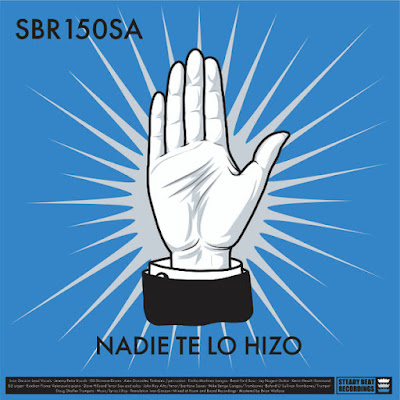
Eric Blowtorch is always doing interesting and unconventional things out in his home base in Milwaukee. For the past decade or so, Blowtorch has been on my radar with incredible releases like 2018's 12" EP Horace Andy backed by Welders "Straight To Hell" and Big Youth backed by Welders "Pair of Dice" b/w Horace Andy v. Big Youth "Asylum Seekers" and Eric Blowtorch "Christmas in Ladbroke Grove" (read my review here) and 2021's triple LP (!) Quality Items (read my review here). But I feel like a dope for not realizing much sooner that I've heard his stuff going back to the '90s with his involvement with Highball Holiday (who released an album on Moon's Ska Satellite Records imprint that I ran and were featured on my comp Skarmageddon 3; and Highball Holiday are now back in action, by the way!).
With an opening guitar riff borrowed from Andy & Joey's "You're Wondering Now," Blowtorch & co.'s great digital single "Sanctuary City," is about welcoming refugees on America's southern border fleeing dictatorships and drug gangs ("Come one, come all/Lift your heart/Crack open the wall/Gunmen on the other side/But maybe love and amnesty, too/Sanctuary city opens/Millions of arms to you"). This track, released just weeks into Russia's appalling invasion of Ukraine, takes on even more significance with millions more people fleeing chaos, death, and destruction in their home countries. The question remains if America can ever find its bearings again to champion human rights and fully welcome and embrace large numbers of refugees from around the world, no matter what their color or religion. ("You're wondering how you should pay/For the way you did behave," indeed.) A portion of this single's proceeds is being donated to the International Rescue Committee, which was founded in 1933 at the suggestion of Albert Einstein (a refugee himself) to help people fleeing fascism in Germany, Italy, and Spain.
+ + + +
It's really heartening to see singer/songwriter extraordinaire Mitch Girio return with new music from his incredible King Kong 4. It's been two years since Punch It, KK4's brilliant compilation of singles, was released by Jump Up (read my review here), and during this period Girio suffered from a virus that caused some sort of brain injury. Thankfully, he's recovered and back in action. This time out, in his fantastically searing "Paper Sky" digital single, Girio sings about an embattled relationship where there's no shelter from the biting lyrics or the metaphorical bombs that rain from above (I can't help from associating this song with nuclear war with Putin's recent threats to use the bomb):
Here we go as we run for cover
Somewhere underneath a paper sky
Is there a place that's the same for lovers
Who never really try?
And you will give your word
Then try to break it
This ska-rock track--shades of Emotional Fascism (aka Armed Forces) era Costello--culminates with an unexpected and thrilling, kick-ass instrumental outro.
Girio also has contributed a hauntingly lovely cover of Umbrella Heaven's "Soulmate" ("Breaking my back for you/You never asked me to") to Perverted Pleasures, a new tribute album to this cult 1990s UK indie rock band.
+ + + +
Smoke & Mirrors Soundsystem's quest for world dominance continues with a cracking new single released on Steady Beat Recordings. (If you don't believe me, check out the slew of records that have come out since their debut 2021 album Strength in Numbers--singles on Badasonic ("Second That Emotion" b/w "Mad World"--read my review here), Liquidator ("Mi Vida Sin Tu Amor" b/w "I'm a Man"--read my review here), and a forthcoming 12" on Jump Up Records featuring Roy Ellis and Monty Nesmith.) As Luis Correa's Steady Beat often focuses on Latin sounds, Smoke & Mirrors Soundsystem's new 7" picture sleeve single features two super crisp Spanish-language Latin ska cuts: John Roy's original "Nadie Te Lo Hizo" b/w a cover of Willie Colón and Hector Lavoe's 1973 salsa cut "El Dia de me Suerte." The theme running through this release is essentially that you should seize the day (side A's title in English is "Nobody Did It To You"; the flip is "My Lucky Day," a tale of passivity in the face of life-long woe: "Soon my lucky day will come/I know before my death/My luck will surely change"). With a never-ending pandemic, worsening global warming, and the looming specter of WWIII, it's probably time to lead your best life while you can. Everybody's got an expiration date.
+ + + +
Eric Blowtorch is always doing interesting and unconventional things out in his home base in Milwaukee. For the past decade or so, Blowtorch has been on my radar with incredible releases like 2018's 12" EP Horace Andy backed by Welders "Straight To Hell" and Big Youth backed by Welders "Pair of Dice" b/w Horace Andy v. Big Youth "Asylum Seekers" and Eric Blowtorch "Christmas in Ladbroke Grove" (read my review here) and 2021's triple LP (!) Quality Items (read my review here). But I feel like a dope for not realizing much sooner that I've heard his stuff going back to the '90s with his involvement with Highball Holiday (who released an album on Moon's Ska Satellite Records imprint that I ran and were featured on my comp Skarmageddon 3; and Highball Holiday are now back in action, by the way!).
With an opening guitar riff borrowed from Andy & Joey's "You're Wondering Now," Blowtorch & co.'s great digital single "Sanctuary City," is about welcoming refugees on America's southern border fleeing dictatorships and drug gangs ("Come one, come all/Lift your heart/Crack open the wall/Gunmen on the other side/But maybe love and amnesty, too/Sanctuary city opens/Millions of arms to you"). This track, released just weeks into Russia's appalling invasion of Ukraine, takes on even more significance with millions more people fleeing chaos, death, and destruction in their home countries. The question remains if America can ever find its bearings again to champion human rights and fully welcome and embrace large numbers of refugees from around the world, no matter what their color or religion. ("You're wondering how you should pay/For the way you did behave," indeed.) A portion of this single's proceeds is being donated to the International Rescue Committee, which was founded in 1933 at the suggestion of Albert Einstein (a refugee himself) to help people fleeing fascism in Germany, Italy, and Spain.
+ + + +
It's really heartening to see singer/songwriter extraordinaire Mitch Girio return with new music from his incredible King Kong 4. It's been two years since Punch It, KK4's brilliant compilation of singles, was released by Jump Up (read my review here), and during this period Girio suffered from a virus that caused some sort of brain injury. Thankfully, he's recovered and back in action. This time out, in his fantastically searing "Paper Sky" digital single, Girio sings about an embattled relationship where there's no shelter from the biting lyrics or the metaphorical bombs that rain from above (I can't help from associating this song with nuclear war with Putin's recent threats to use the bomb):
Somewhere underneath a paper sky
Is there a place that's the same for lovers
Who never really try?
And you will give your word
Then try to break it
This ska-rock track--shades of Emotional Fascism (aka Armed Forces) era Costello--culminates with an unexpected and thrilling, kick-ass instrumental outro.
Girio also has contributed a hauntingly lovely cover of Umbrella Heaven's "Soulmate" ("Breaking my back for you/You never asked me to") to Perverted Pleasures, a new tribute album to this cult 1990s UK indie rock band.
+ + + +
Smoke & Mirrors Soundsystem's quest for world dominance continues with a cracking new single released on Steady Beat Recordings. (If you don't believe me, check out the slew of records that have come out since their debut 2021 album Strength in Numbers--singles on Badasonic ("Second That Emotion" b/w "Mad World"--read my review here), Liquidator ("Mi Vida Sin Tu Amor" b/w "I'm a Man"--read my review here), and a forthcoming 12" on Jump Up Records featuring Roy Ellis and Monty Nesmith.) As Luis Correa's Steady Beat often focuses on Latin sounds, Smoke & Mirrors Soundsystem's new 7" picture sleeve single features two super crisp Spanish-language Latin ska cuts: John Roy's original "Nadie Te Lo Hizo" b/w a cover of Willie Colón and Hector Lavoe's 1973 salsa cut "El Dia de me Suerte." The theme running through this release is essentially that you should seize the day (side A's title in English is "Nobody Did It To You"; the flip is "My Lucky Day," a tale of passivity in the face of life-long woe: "Soon my lucky day will come/I know before my death/My luck will surely change"). With a never-ending pandemic, worsening global warming, and the looming specter of WWIII, it's probably time to lead your best life while you can. Everybody's got an expiration date.
+ + + +
Subscribe to:
Posts (Atom)


